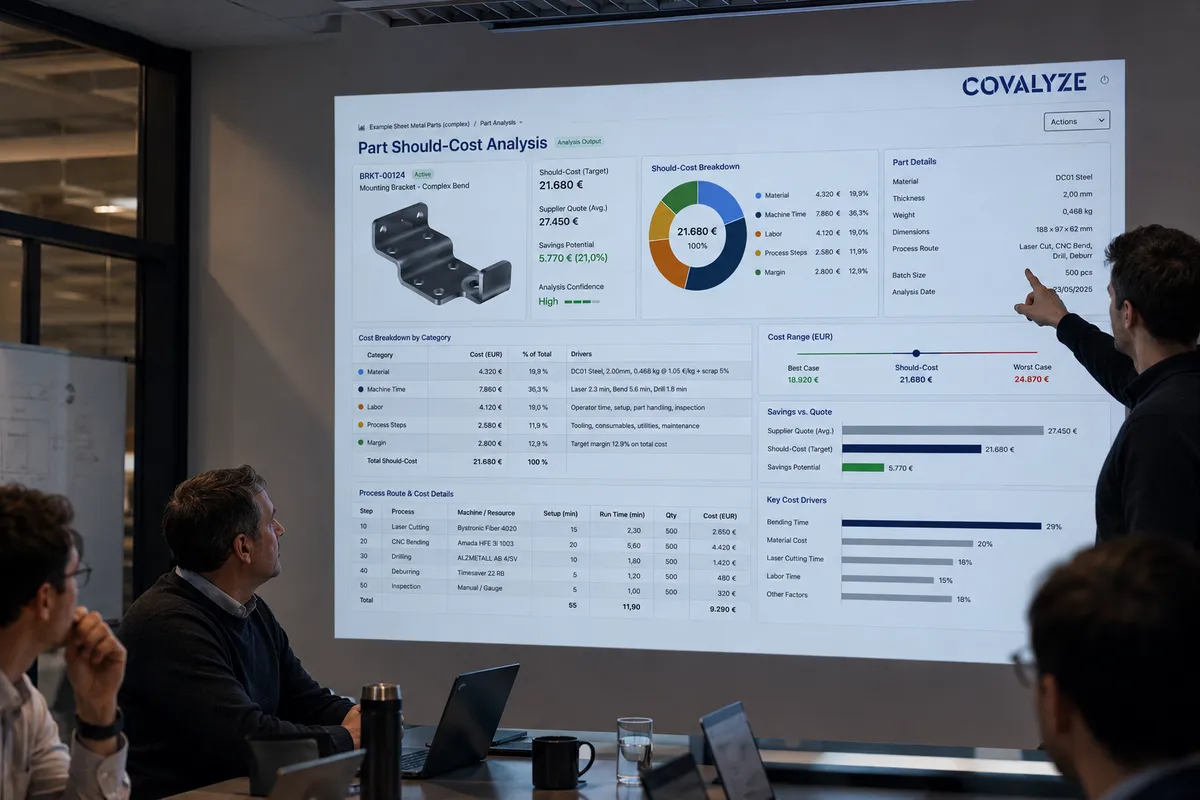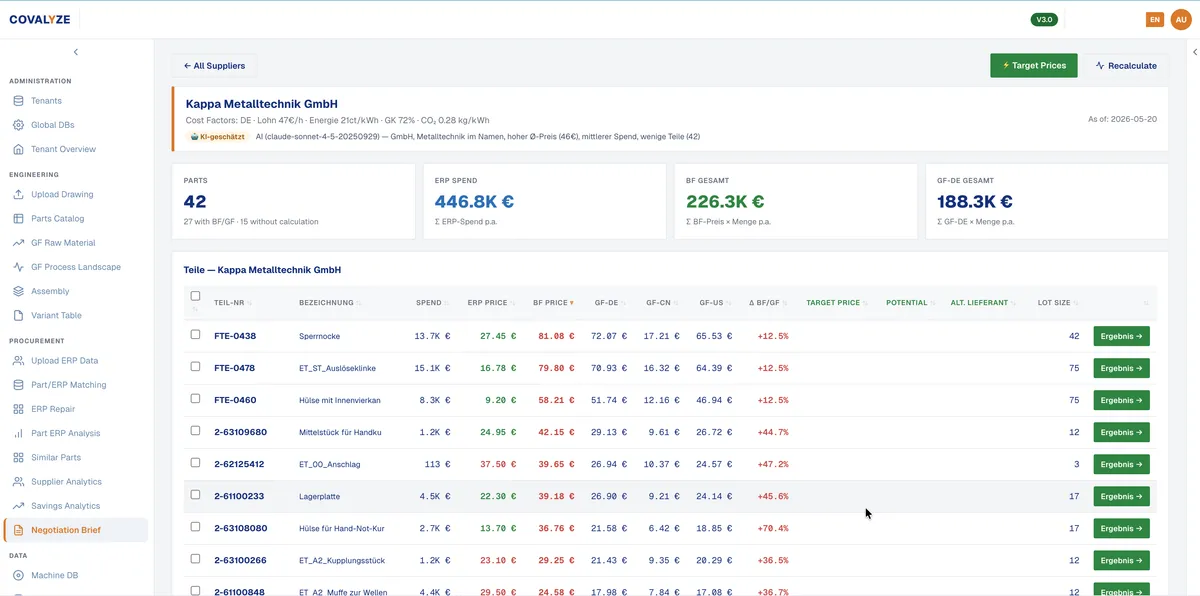
When procurement teams test a new supplier, they usually start from a simple question: can this supplier produce the part more cheaply than the current one? It is a reasonable question, and it is incomplete, because no supplier prices a part in isolation. A supplier prices a basket.
Inside that basket, some positions are priced aggressively to win attention and others carry more margin. A few line items are calculated properly, while the rest are estimated defensively because the supplier does not yet believe the opportunity is real. A single-part benchmark cannot separate those cases, which is why it says so little about the supplier behind the number.
A cheap part does not mean a cheap supplier, and a competitive quote does not mean a competitive cost structure.
To find out whether a supplier is genuinely competitive, procurement has to test it across a representative basket of parts and compare the result against a technical cost baseline. That is where COVALYZE changes the process.
Why traditional supplier tests are easy to misread
A typical supplier test starts with drawings, quantities and a request for quotation. The buyer sends a handful of selected parts to a potential supplier, the supplier responds with prices, and procurement compares the new quote against the incumbent or against historical prices. On the surface that looks like a clean benchmark.
The problem sits inside the quote. A supplier can be very competitive on the visible or familiar parts while pricing the less visible items much higher. The total still lands in an acceptable range, or the buyer focuses on the headline saving and never looks further.
This is rarely bad intent, just ordinary commercial behavior. When a supplier receives an unclear request, cannot tell how serious the buyer is, or suspects that the whole exercise exists to pressure the incumbent, it protects itself: risk buffers go in, some items get sharpened, and the margin is recovered elsewhere. What comes back is a negotiation signal rather than a clean supplier test, and procurement has to read it as one.
Is the supplier consistently competitive?
Whether one part is cheaper is the wrong test. What procurement needs to know is whether the supplier holds its cost position across the full basket, and answering that means looking past the total into the line-item pattern.
Single-part benchmark
What the usual test asks
- Is this part cheaper than what we pay today?
- How does the total compare with the incumbent?
- Did we get a double-digit saving?
Full-basket test
What the supplier test should ask
- Where does the supplier sit below the expected cost level, and where above it?
- Which positions look properly calculated, and which look estimated?
- Which prices are buffered, and which are used to recover margin elsewhere?
- Does the pattern hold across sizes, complexities and quantities?
The second column is where a supplier test becomes informative. The first column can be answered without learning anything about the supplier.
That pattern usually matters more than the total. A supplier sitting slightly above target across the whole basket may be easier to negotiate with than one that is cheap on a few obvious parts and expensive on many others. The first supplier needs alignment. The second is pricing selectively, and the gap will reappear on every part that follows.
Scenario 1: the attractive single-part benchmark
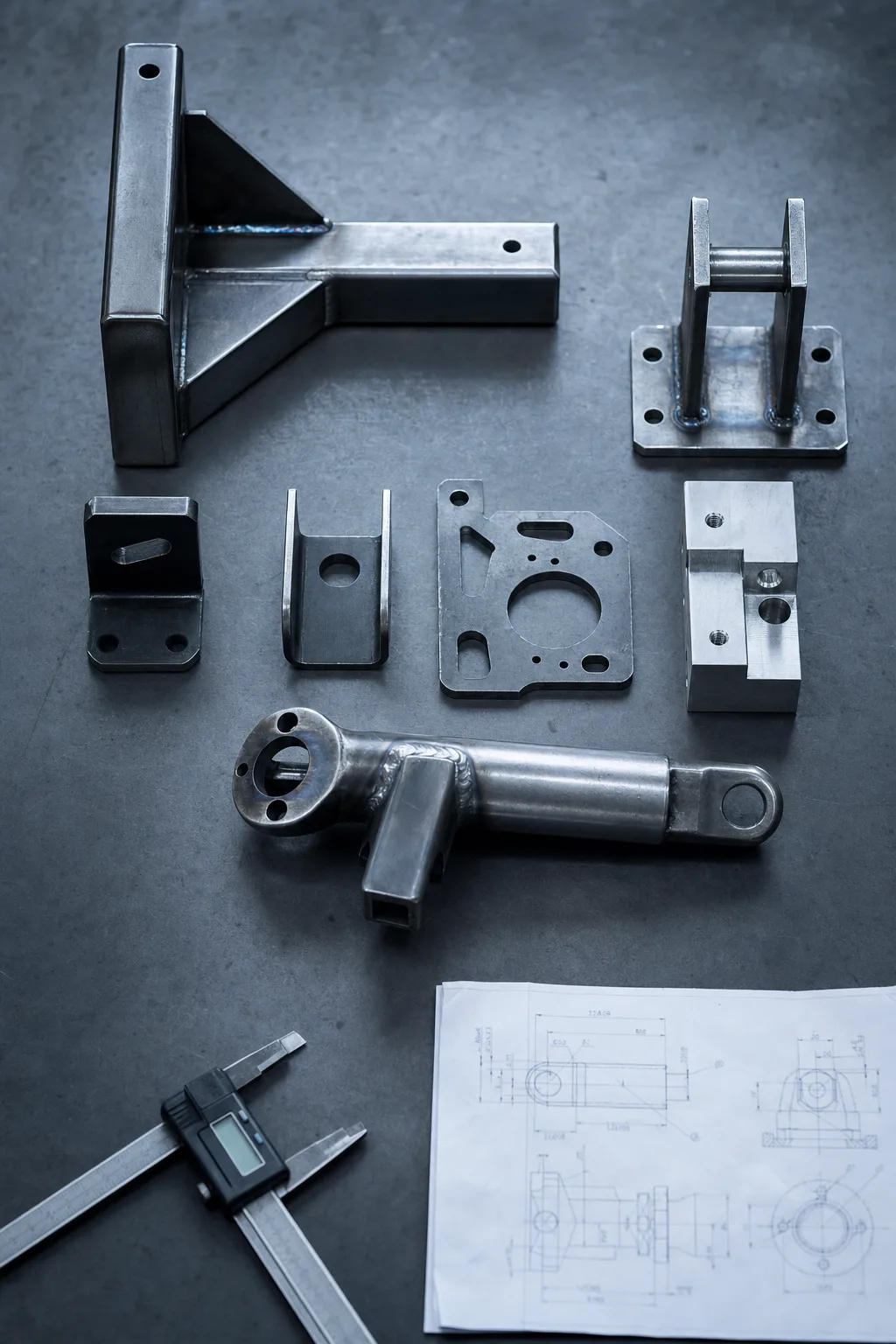
Take an engineering-to-order company that buys welded assemblies from long-standing local suppliers. Management wants to know whether alternative suppliers in another region could be competitive, so procurement sends one representative welded component to a new supplier. The quote comes back below the current price, and on paper that reads as a success.
It tells the company very little. One part can be easy to manufacture, attractive to that particular supplier, or priced sharply to open the door. None of that reflects the true cost position of the assembly family behind it.
Basket design
A basket that varies size, weight, welding effort and quantity tests the supplier's cost logic, not its appetite for one part.
Build the basket to expose the cost structure
Instead of benchmarking one component, the company selects a representative basket: different sizes and weights, different welding complexity, different cutting effort, different setup requirements and different quantities.

COVALYZE calculates a technical target cost for that whole basket before the supplier quote arrives, covering material, process steps, machine time, setup time, labor, overhead and regional cost assumptions.
The question to the supplier changes as a result. Instead of asking what the price is, procurement can ask where the quote differs from the cost logic and why. That is a far stronger test.
Scenario 2: the supplier looks cheap until the basket is analyzed
In a second case, the quote looks attractive on the total and procurement is ready to move forward. Comparing every quoted line item against the technical cost baseline produces a different picture.
The supplier is very competitive on several large, visible parts, which are exactly the ones a buyer checks first. On the smaller and less obvious positions it sits far above the calculated cost level. The total still looks acceptable because the visible parts create confidence, but the basket shows a supplier that is not consistently competitive. It is shifting margin across the quote.
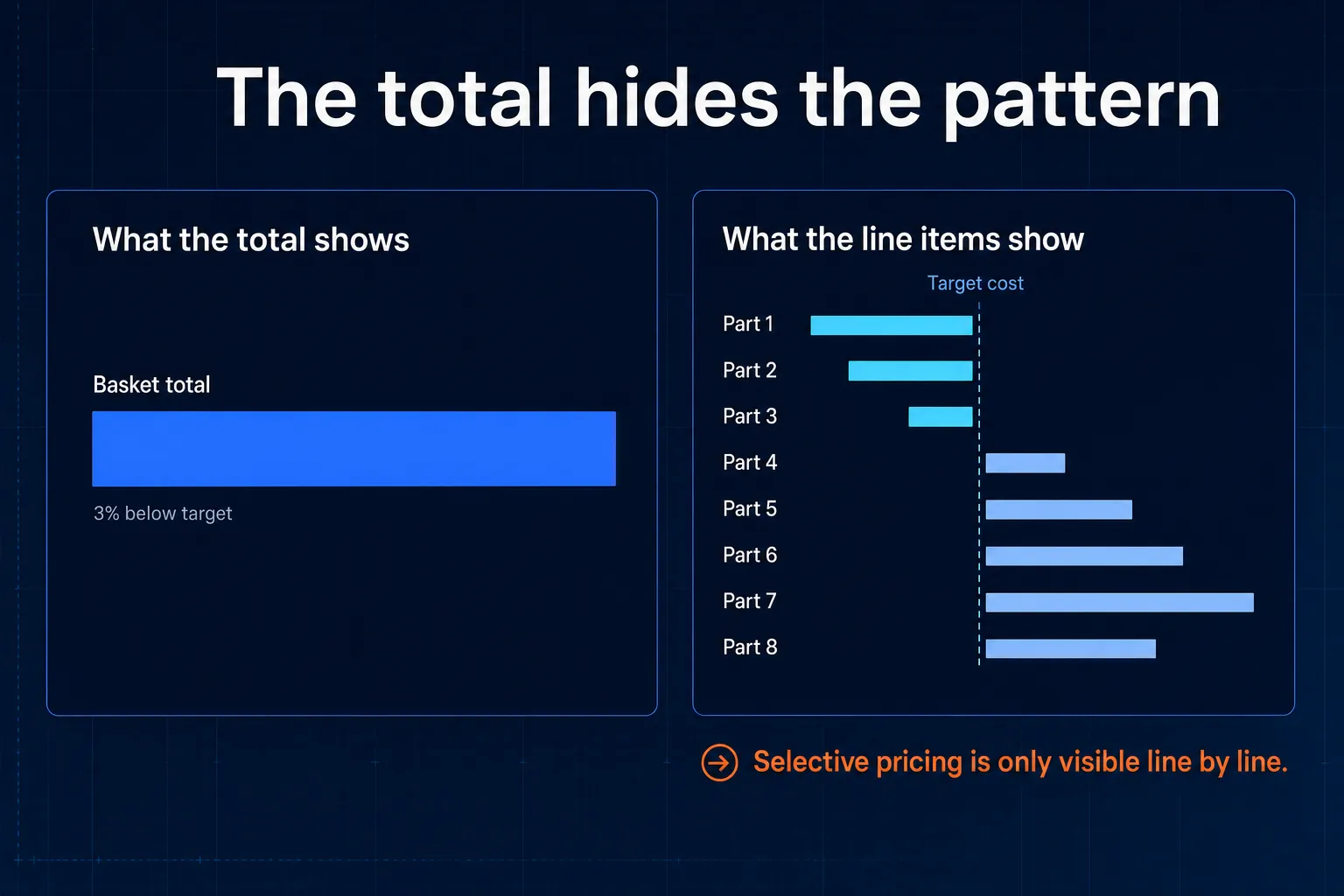
Without a technical cost baseline, procurement can end up rewarding the wrong supplier and locking in a pricing pattern that gets more expensive with every follow-up part. With one, the distinction between a structurally competitive quote and a selectively attractive one is visible before the award.
Scenario 3: the supplier quotes defensively
Not every high quote is a bad quote. Suppliers also quote defensively when they do not trust the process, which happens often when a company with strong incumbent relationships approaches someone new. The supplier assumes the request is a benchmarking exercise meant to squeeze the current partner, so it protects itself.
Reading the signal
Buffers, round numbers and missing detail usually mean the supplier did not invest in a real calculation.
A defensive quote is a comment on the request
The supplier adds buffers, avoids detailed calculation and quotes high enough to cover the uncertainty. Nobody invests in a proper line-by-line costing for an inquiry they expect to lose.

From the buyer's side the result looks disappointing, and the conclusion tends to be that the supplier is expensive. The cause may instead be the way the request was framed.
Sharing target-cost logic, cost corridors or structured feedback signals that the buyer has done the work and understands the manufacturing cost structure. The supplier then sees a serious opportunity, and the buyer finds out whether the supplier can work to a transparent target instead of guessing at one.
Why target costs change supplier behavior
A supplier behaves differently when the buyer understands cost. Send only drawings and a request for prices, and the supplier controls the discussion: it decides how much detail to provide, where to place risk buffers and how to structure margin. Enter the same discussion with a transparent target-cost model and that control is shared.
The supplier can see that the buyer knows the main cost drivers:
- material usage
- cutting time
- welding time
- setup effort
- machine time
- labor assumptions
- overhead assumptions
- quantity effects
- regional cost differences
What follows is a more professional conversation. Rather than negotiating around a vague discount demand, both sides can work through the actual drivers: whether the setup effort is higher than assumed, whether the welding complexity was underestimated, whether the material assumption is wrong, whether the batch size is inefficient, whether the supplier uses a different process, or whether risk was added because the future volume is unclear. Those questions produce better outcomes than asking for a lower price.
Scenario 4: the incumbent is not always the problem
Supplier testing is usually framed as a search for cheaper alternatives, and it can just as easily protect the incumbent. A long-standing supplier may look expensive next to a new quote, but if the technical cost baseline puts the incumbent price close to the calculated level, the conclusion flips: the incumbent is not overpriced, and the newcomer is either underestimating the complexity or buying the first order with a price it intends to correct later.
So supplier testing should lead to supplier understanding rather than automatic supplier switching. Depending on what the basket shows, the right move can be to negotiate, to qualify an alternative, to keep the existing supplier, to develop it, to set up a dual source, or to define a pricing formula for future parts. Knowing which of those applies is worth more than replacing anyone.
Why full-basket testing matters in project business
In plant engineering, warehouse automation, machinery, steel construction and custom industrial equipment, every project looks different. Assemblies are adapted to customer requirements, engineering changes are frequent, quantities are low, and many parts are manufactured once or in small batches.
That creates a lot of quotation effort. Engineering finishes a design, procurement sends drawings to suppliers, suppliers need time to calculate, buyers wait for offers, engineering adjusts, and the end customer waits for a final quotation. Weeks pass between the technical design and reliable cost information, and that delay is expensive: it slows down quoting, postpones customer decisions, adds uncertainty to margin planning and keeps procurement in a reactive position.

A technical cost baseline removes most of that wait. With COVALYZE, a company can estimate the cost of new parts as soon as the drawing or 3D file exists, and compare regions, suppliers and manufacturing assumptions before the formal supplier quote comes back. In project business, that time-to-market advantage often outweighs the purchase-price saving.
From quote gambling to pricing logic
Without a cost baseline, supplier selection turns into quote gambling. The same drawings go out to several suppliers and the buyer waits. One supplier has capacity and quotes low, another is busy and quotes high, a third misunderstands the part, and a fourth adds buffers because the request looks uncertain. The cheapest quote wins, which is not the same as the best supplier winning. It may only mean that one supplier had the right workload, the right assumptions or the strongest appetite for work on that particular day.
Pricing model
A cost formula turns every future part into a calculation rather than a new round of quotations.
Negotiate the drivers once instead of the price every time
COVALYZE lets companies move from repeated one-off quotations to structured cost formulas.
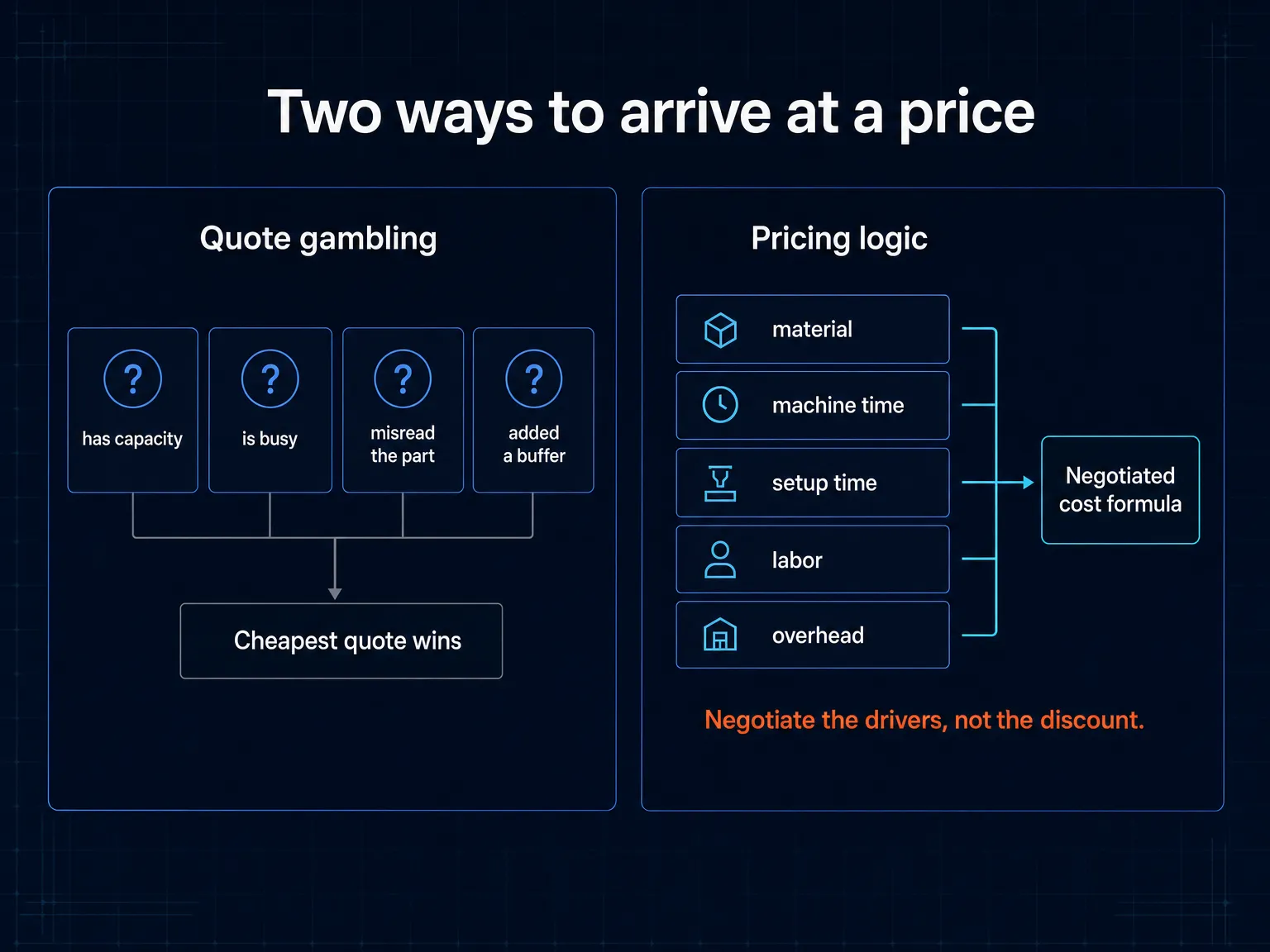
Instead of asking suppliers to recalculate every new part from scratch, procurement negotiates the underlying drivers: machine rates, setup logic, process formulas, material handling, overhead and quantity effects.
Pricing for future parts becomes predictable, and the strategic benefit shows up as speed and consistency long before it shows up as savings.
Scenario 5: the framework agreement
Consider a company that regularly designs new welded assemblies for customer projects. Every project creates new drawings, every drawing creates new supplier requests, every request creates waiting time, and every waiting cycle delays the final customer quote.
Now give that company a framework agreement built on transparent cost logic. When a new part is designed, COVALYZE calculates the expected cost from geometry, material, process time, setup and regional cost assumptions, and the supplier's pricing model already follows the same framework. The buyer no longer starts from zero, and negotiation is only needed where the part deviates from the expected logic.
The business impact shows up mainly in speed rather than in the purchase price: faster customer quotations, faster engineering decisions, and project margins that hold because they were calculated on something.
What COVALYZE makes visible
COVALYZE turns supplier testing from quote comparison into cost-structure validation. Across a representative basket, it shows:
- whether a supplier is consistently competitive or only selectively attractive
- where a quote contains selective pricing
- whether an offer is defensive or seriously calculated
- which line items need clarification
- whether the target costs themselves are realistic
- whether the incumbent is actually overpriced
- whether a new supplier's price level is sustainable
- whether a framework price logic is possible
- how future parts could be priced without a new quotation round
Supplier negotiation, supplier relationships and procurement judgment all stay where they are. They just get a factual basis to work from.
Conclusion: test the supplier, not the part
A supplier test built around one attractive benchmark part answers the wrong question. Built around a representative basket, it answers the one that matters: whether the supplier is structurally competitive and commercially serious enough for the business that follows. That requires a technical cost baseline before the quote comes back.
The real risk is not that one part is too expensive. It is that the quote looks good while the pricing logic behind it is wrong.
See how COVALYZE Analytics and PartIQ turn part-level cost logic into full-basket supplier tests, defendable target costs and framework pricing for the parts you have not designed yet.