DARIN · DESIGN + AUTOMATE
See what a design decision costs before it is released.
Material, wall thickness, an extra bend, a tighter tolerance, a different process — each one priced while the design is still open. This is where the largest jumps sit, because nothing has been frozen yet.
TWO LEVERS, ONE CALCULATION
Change the part, or change how it is made.
Two different levers
Design changes the part. Automate changes how it is made.
The two get mixed up constantly, and it matters: one needs an engineering release, the other usually does not. Keeping them apart tells you who has to approve a saving before it can happen.
D · Design
Change the specification or geometry
- Material substitution — a different alloy, a cheaper coating
- Less weight: thinner walls, reduced stock, fewer reinforcements
- Simplified tolerances where function does not need them
- Removing a feature that requires an operation of its own
- Consolidating near-identical variants into one part
- Needs an engineering decision and usually a re-validation
A · Automate
Change the process, equipment or automation
- Milling replaced by casting once the volume carries the tool
- Laser cutting replaced by punching at higher quantities
- A machine rate that fits the step instead of the fastest machine available
- Manual assembly against an automated station
- Re-sequencing the chain so a handling or deburring step disappears
- Function and drawing stay as they are — the route changes
Both are calculated on the same cost model, so an option that changes the part and one that only changes the route can be compared on the same basis.
The same part, two levers, two very different answers.
FTE-0001 is a laser-cut and bent sheet-metal bracket. On this part the material dominates the price — which makes the Design lever powerful and the Automate lever nearly irrelevant. On a part with long machining times it is the other way round. That is the whole reason both get calculated.
| Lever | As designed | Alternative | What the calculation shows |
|---|---|---|---|
| Design Material and weight | Steel · 2.12 €/kg · 13.6 kg | Aluminium · 4.35 €/kg · 4.7 kg | Material cost comes out lower despite the higher price per kilo, because the part loses roughly two thirds of its weight. Whether it is an option at all is an engineering question — the calculation only says what it would be worth. |
| Automate Cutting process and machine rate | Fiber laser · 38.10 €/h · 5,000 mm/min | Mechanical shear · 13.00 €/h · 7,000 mm/min | A few euros. Cutting is a small share of a material-dominated price, so switching the process here would be effort spent in the wrong place. |
| Design An additional bend or a tighter tolerance | As drawn | One more bend, or a tolerance one class tighter | Each addition is its own line in the calculation — a bend appears as one bend × its handling time on the press brake. A tighter tolerance can pull in a different machine or an extra operation. Priced at concept stage this is a decision; priced after release it is a change request. |
Example values from the FTE-0001 sheet-metal part in the DARIN calculator. An example, not a commitment. Average savings potential identified in COVALYZE Fast Track and platform engagements since 2019. Identified potential is not the same as realised savings — actual results vary by commodity, supplier base, quantity structure and data quality.
What the calculation does not decide
The cheapest variant is not automatically the right one.
A cost model can rank options. It cannot approve them. These are the constraints that decide whether a priced alternative is an option at all — and they stay with your engineers.
Ranked by the model
Approved by your engineers.

08 constraints
-
Mechanical performance
Strength, stiffness, fatigue, thermal behaviour. A lighter variant that no longer carries the load is not a saving; it is a different part.
-
Tolerances and fit
A tolerance is only expensive if it is unnecessary. Where it controls fit, sealing or assembly, it stays — and the calculation shows what it costs to keep.
-
Certification and approval
Regulated products, customer approvals and qualified processes limit what may change at all. In those cases the interesting scenarios are the ones that do not touch the approved specification.
-
Surface, corrosion and environment
A cheaper coating that shortens service life moves cost rather than removing it. The comparison has to be like for like on requirements, not just on price.
-
Volume and tooling investment
Casting instead of milling, or punching instead of laser cutting, only pays above a certain quantity. The tool is part of the calculation, and so is the volume it has to be amortized over.
-
Supplier capability
An alternative process is worth nothing if the supplier cannot run it. That is why the calculation can use the actual rates and equipment of the producing plant rather than an industry average.
-
Change and validation cost
Re-validation, sampling, documentation and PPAP effort belong in the business case. A saving of a few cents per piece can easily be smaller than the change that unlocks it.
-
Quality and reliability
Scrap, rework and field failures are cost too. If a variant is cheaper to make but harder to produce reliably, that has to be on the table before anyone decides.
The earlier the number arrives, the more it is worth.
Cost is not set when the quotation comes in. It is set in the six moments below — and DARIN is useful in all of them, most of all in the first.
About the 30%
Up to 30% in development — and why the number is so much lower later.
In an existing commodity group we identify 6.5% savings potential on average. In product development the figure can reach up to 30% of product cost. Both numbers are honest, and the difference between them is not method — it is timing.
Once a design is released, the material is chosen, the geometry is fixed, the process follows from it and a supplier has been nominated. What is left to negotiate is a few percent. Before release, all of those are still variables, so the cost model can compare genuinely different options rather than shades of the same one.
The conditions attached to the higher figure are worth stating plainly: it applies to development projects where the design is still open, where alternatives are technically permissible, and where engineering is willing to act on the result. It is a potential identified before design freeze, not a saving that lands automatically in the P&L.
Average savings potential identified in COVALYZE Fast Track and platform engagements since 2019. Identified potential is not the same as realised savings — actual results vary by commodity, supplier base, quantity structure and data quality.
A cost per characteristic, not a cost per part.
Engineering cannot act on a single part price. What is useful is which feature carries which cost, what the alternatives would be worth, and what changing them would cost to validate.
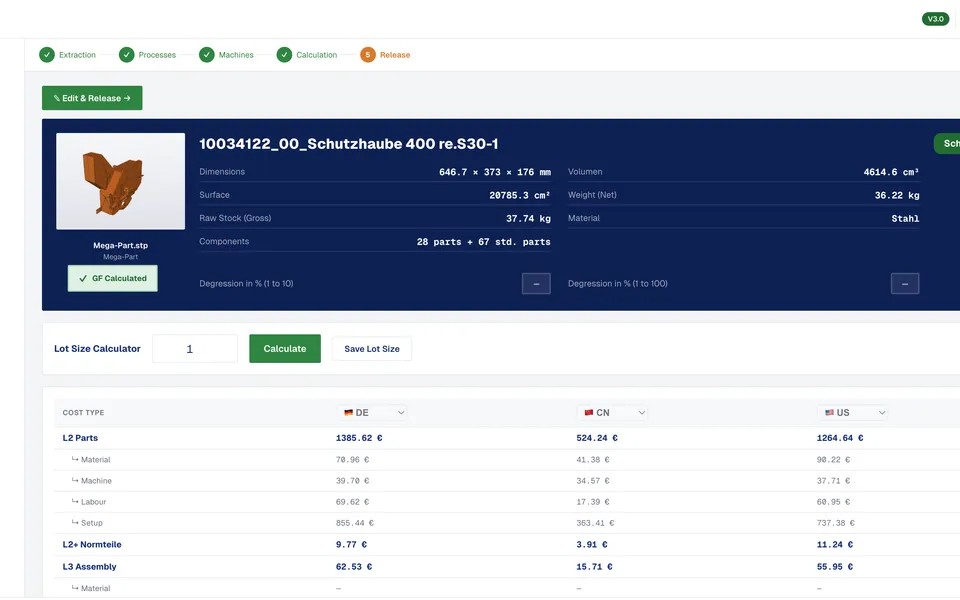
Where a design decision turns into hours and euros.
Two views engineering can act on: the process chain, where every operation carries the drawing input and the formula that turns it into time, and the similar-part map, where variants of near-identical parts sit next to each other with their cost gaps visible.
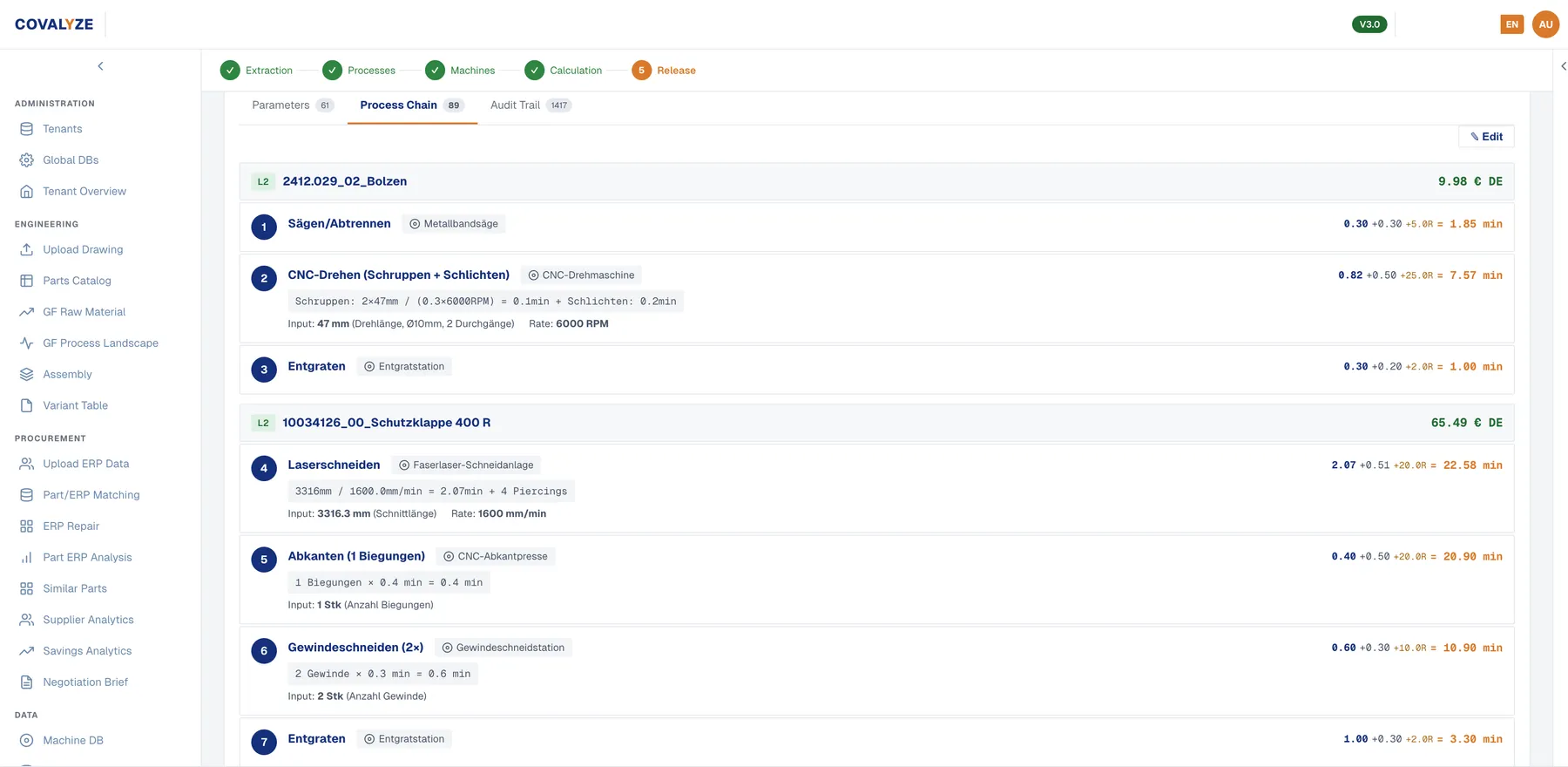
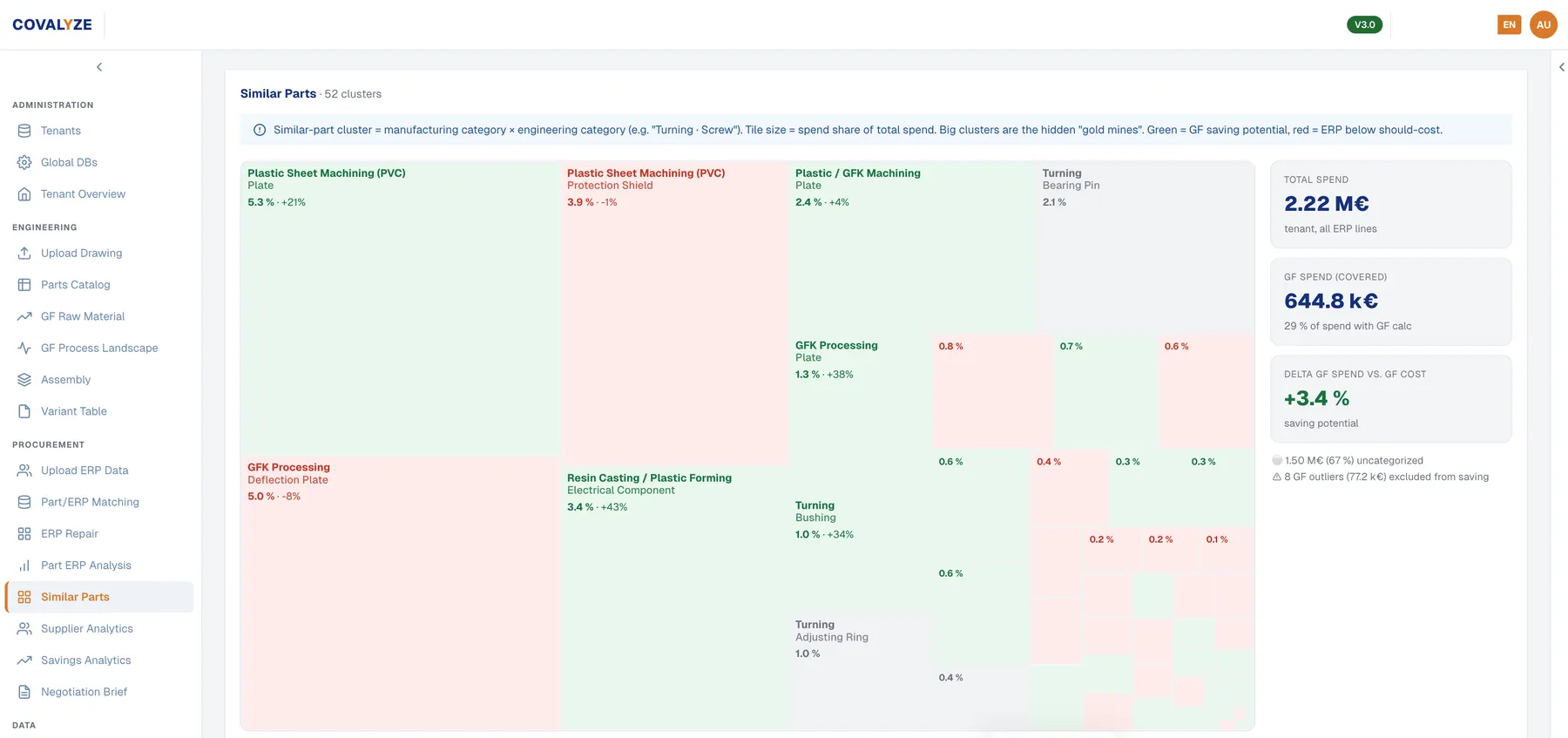
Screenshots from a demonstration tenant. Values depend on the parts, materials and quantities in your own data.
Client result · forklift carriages
Three design parameters explained most of the cost variance.
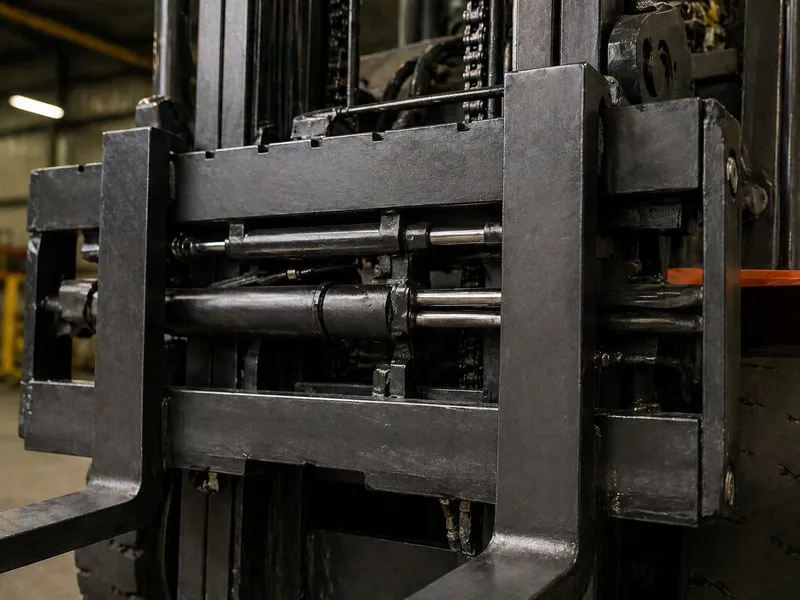
Across 75 heavy welded carriage assemblies with up to 15 components each, mast upright thickness, front plate type and front plate height turned out to explain the majority of cost differences — at a model fit above 92%. That is a design-to-cost finding, not a procurement one: it tells engineering which three decisions to look at before drawing the next carriage, and it made over-engineering visible as a number.
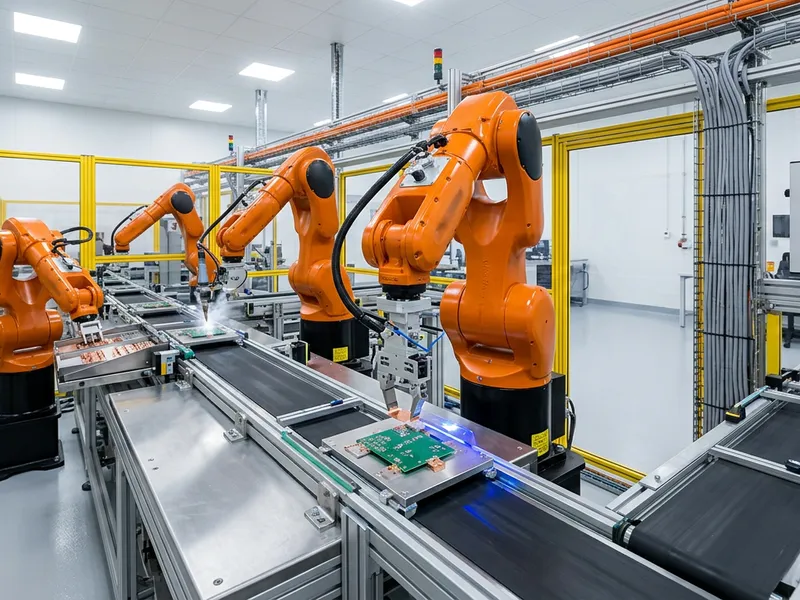
In the automotive contacts category the same logic pointed at material: semi-finished material accounted for more than 55% of direct cost, with silver alone up 178% in price development — which is what makes substitution worth evaluating where it is technically feasible.
Where design and process decisions carried the cost.
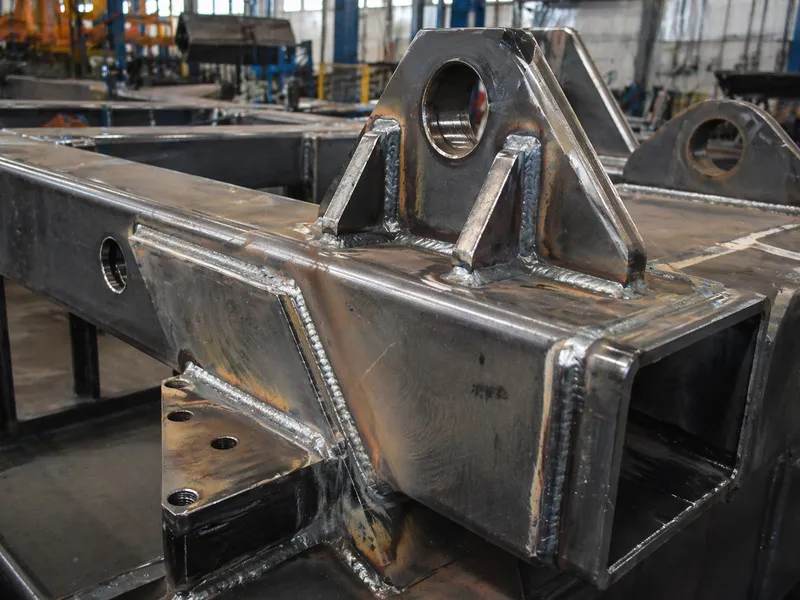
A few more client results from the case library, each driven by the same markdown-based format.
Average savings potential identified in COVALYZE Fast Track and platform engagements since 2019. Identified potential is not the same as realised savings — actual results vary by commodity, supplier base, quantity structure and data quality.
Design and Automate are two of five.
A design decision is rarely isolated: a lighter part may also change the country that makes sense, and a process change can shift the quantity logic.
- D Design Material and weight You are here
- A Automate Process route and machine-hour rate You are here
- R Re-locate Labour, energy and overhead per country
- I Identify The individual plant’s rates instead of a country average
- N Negotiate Order quantity and setup-cost allocation
Design-to-cost — frequently asked questions.
Using it in development
Scope and limits

Price the decision while it is still a decision.
Send a concept drawing, a 3D model or a part that is already in series. You get the cost per characteristic, the priced alternatives, and what each one would have to clear before it becomes a recommendation.