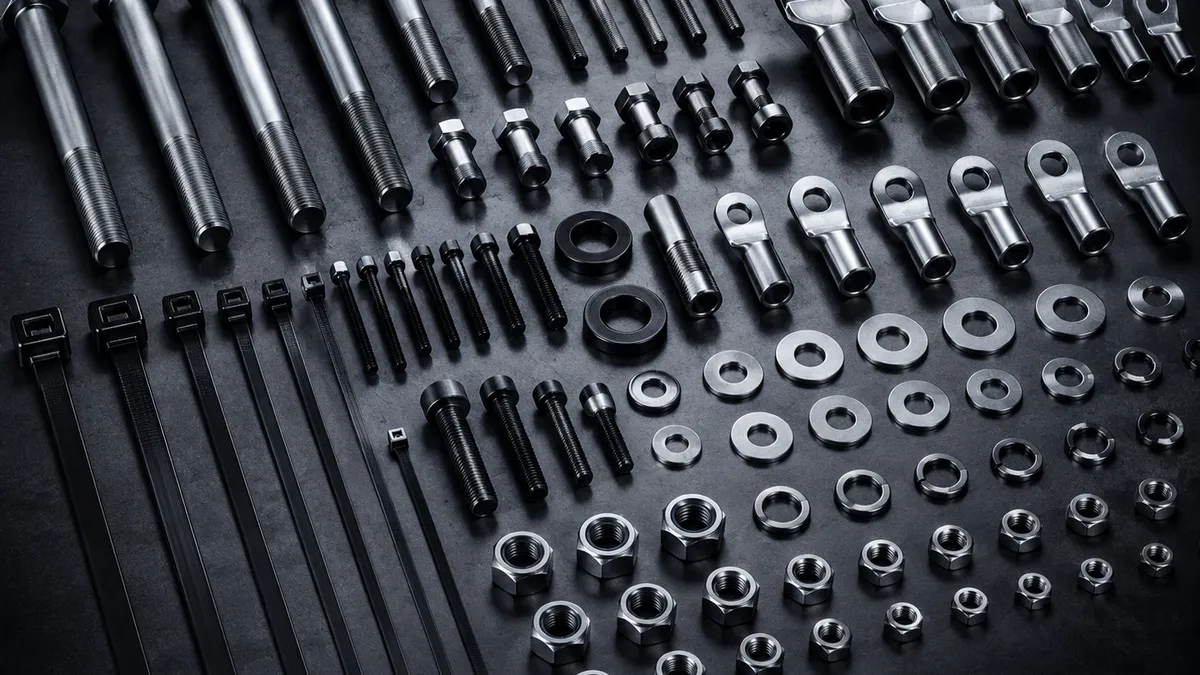
Screws, washers, cable ties, cable lugs, sheet blanks: individually they never attract the attention a welded assembly or a precision-machined component gets. Across a portfolio they add up. In one recent analysis of a mid-sized manufacturer, more than 1,800 part numbers were in scope and almost half of them were catalog or standard parts. Our new industry insight looks at why that half is usually assumed to be optimized, and why the assumption often does not hold.
The value professional C-parts suppliers create is real and worth saying out loud. Broad assortments, ERP catalog integration, automated ordering, reliable logistics, production-related supply concepts, sometimes consignment stock on site. C-parts management has traditionally focused on process cost reduction for good reason: a well-integrated catalog supplier genuinely cuts administrative effort.
The blind spot is that a process can run smoothly while the price structure underneath it drifts. Old price lists get carried forward, new parts are added without systematic benchmarking, discounts are applied inconsistently, and high-runner items are negotiated hard while long-tail items are simply accepted. The catalog still works operationally. It is no longer commercially optimized.
One anonymized case in the article covers more than 400 screw positions and turns up the opposite of what procurement expects. For technically comparable screws, higher quantities came with higher prices. That finding was only possible because the analysis controlled for screw type, size, length and coating first, which is exactly the argument a supplier uses to say two parts are not really comparable. The article sets out how PartIQ and COVALYZE make that comparison hold, without disturbing the supply concept that already works.