Industrial companies are changing what they expect from consultants.
For decades, many consulting projects were built around data preparation, benchmarking, Excel analysis, external validation and slide-based recommendations. That work created value when internal data was fragmented, analytical capabilities were scarce and management needed an external perspective to structure decisions.
AI is changing that model.
Manual number crunching is losing value. Data can be structured faster, enriched more easily and analyzed at a scale that used to require large project teams. Consulting does not disappear because of that, but what clients are willing to pay for does change: measurable impact, technical depth, auditable models, faster execution and real implementation capability. That is what result-driven consultancy means.
In industrial cost analysis the shift is especially visible. Generic cost-saving claims no longer land. What companies want is a transparent cost model that explains why a part, product, supplier quote or business case is economically plausible.
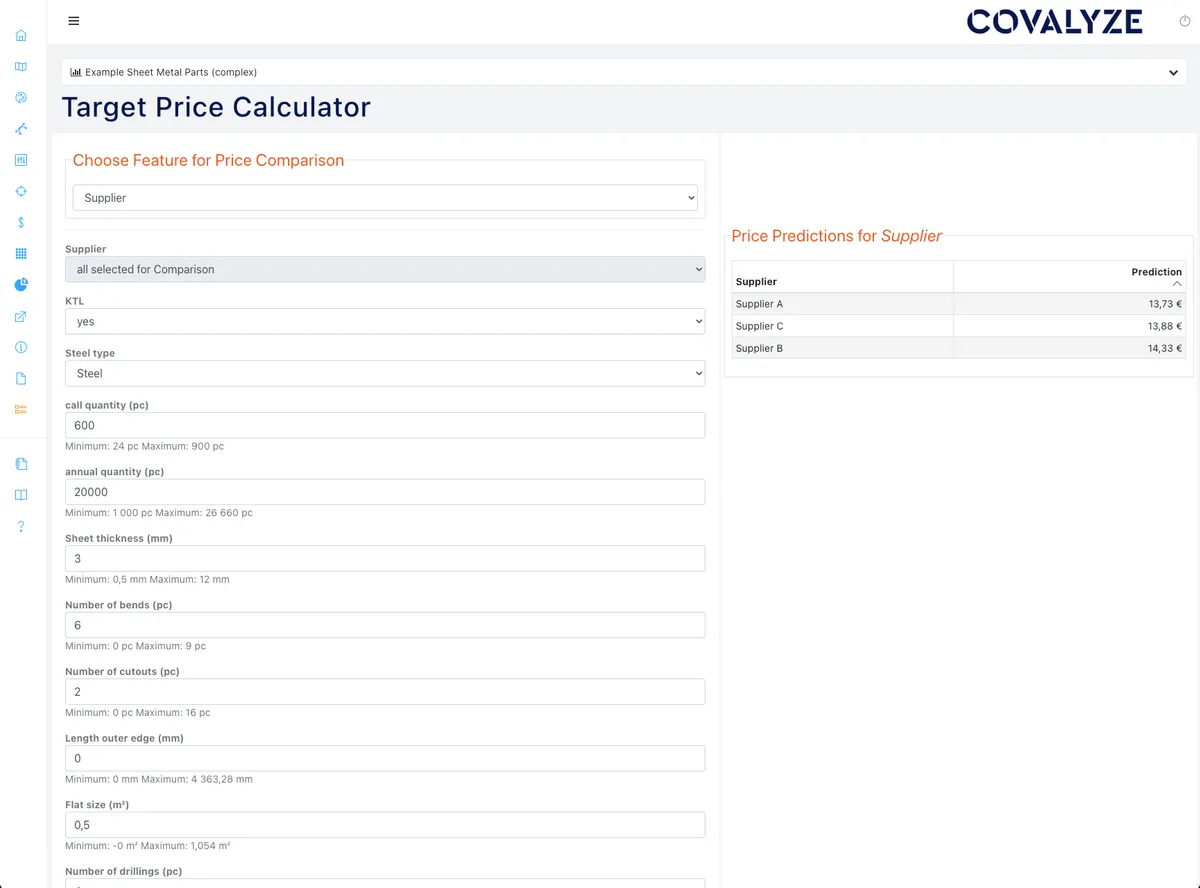
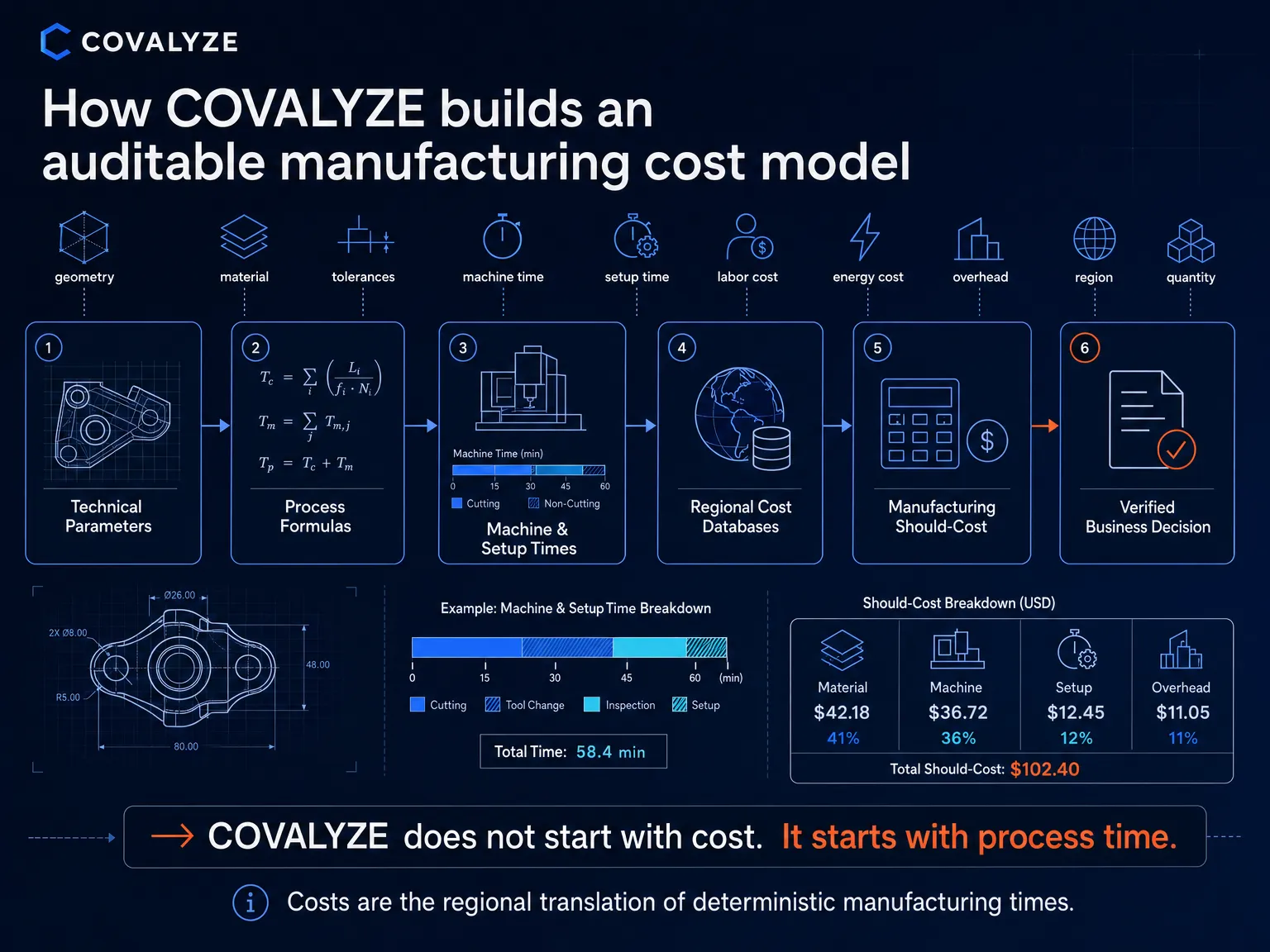
That is where COVALYZE fits. COVALYZE provides an auditable manufacturing cost model. Technical parameters are translated into process times, and process times into regional manufacturing costs using curated machine, material, process and regional databases. What comes out is a transparent cost logic rather than a black-box AI estimate, one that can be reviewed, challenged and used in negotiations, make-or-buy decisions, product costing and investment validation.
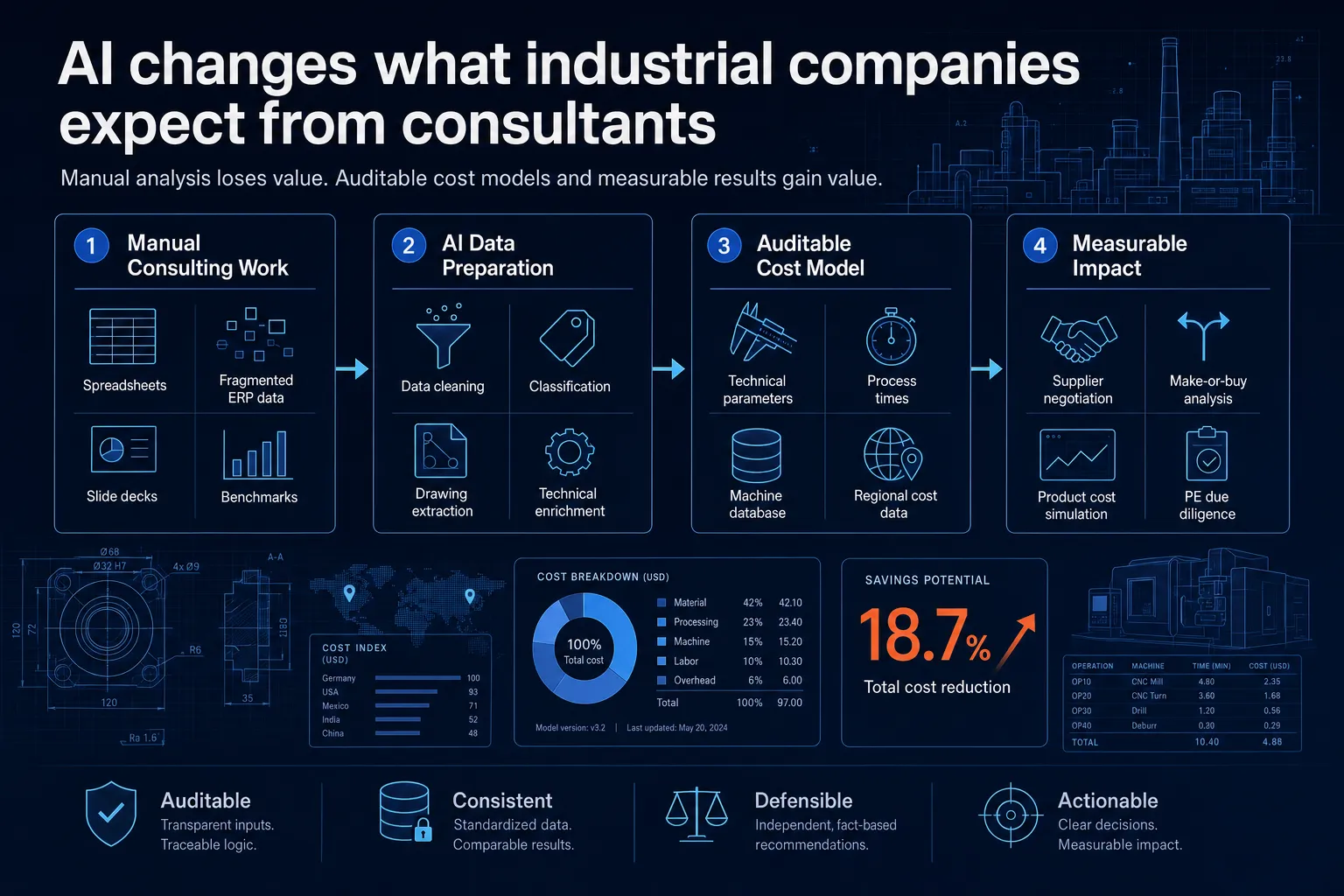
The old consulting model: analysis capacity and external validation
Industrial companies historically used consultants for a recurring set of reasons. Most of that work now runs on software, and the two sides of the shift line up almost item for item:
Before AI
Why industrial companies hired consultants
- internal teams lacked the time or tools to structure complex data
- ERP and procurement data were incomplete or inconsistent
- benchmarking required external experience
- management needed an independent perspective
- internal recommendations needed external validation
- complex projects required structured project management
- decisions needed to be translated into board-ready narratives
After AI
What now runs in a fraction of the time
- data cleanup
- part classification
- document extraction
- supplier and category clustering
- technical parameter enrichment
- spend pattern detection
- variance analysis
- first-pass recommendations
- scenario generation
- report preparation
What used to be the billable core of a project has become a setup step.
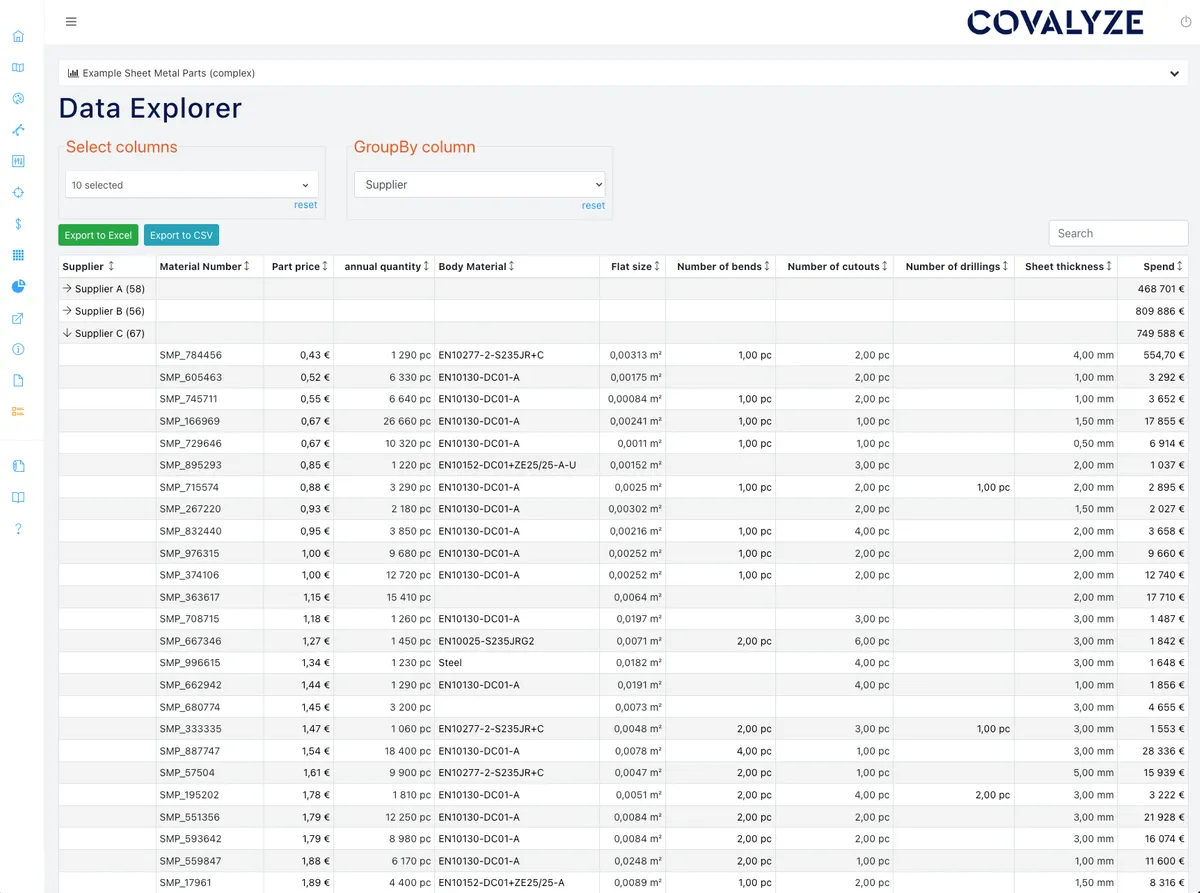
This was especially true in procurement, supply chain, operations and engineering-related cost analysis. Many projects began with fragmented data: supplier lists, spend files, part numbers, drawings, BOMs, purchase orders, price histories and incomplete material information. A large share of the consulting effort went into cleaning, grouping, normalizing and interpreting those inputs, and that used to be valuable work.
What AI changes
AI changes the economics of consulting analysis. Data can be structured, enriched and screened at a scale that used to require a full project team and several weeks.
None of that makes an AI-generated result correct. In industrial contexts the opposite holds: AI results have to be verified carefully. What changes is the role of the consultant.
Manual analysis capacity alone no longer justifies a fee. Clients expect consultants to bring better tools, proprietary data, technical understanding and the ability to verify and implement results.
The consulting value proposition shifts from:
"We will analyze your data and tell you what we found."
to:
"We will use technology to create a verifiable fact base faster, then help you turn it into measurable business impact."
From estimate to decision basis
A black-box recommendation may be fast, but only an auditable model can be reviewed, challenged and used in a negotiation.
AI accelerates the fact base. Auditability makes it trustworthy.
AI can clean, classify and enrich industrial data at a scale that once required large project teams. That collapses the cost of building a fact base, without making the result credible on its own.
Procurement leaders, CFOs, COOs and investors need to understand how a number was calculated before they act on it. Speed without transparency is not a decision basis.
The value therefore moves downstream: away from producing the analysis, toward verifying it, prioritizing it and turning it into implemented measures.
The rise of result-driven consultancy
Consulting is moving toward measurable outcomes. Clients have grown skeptical of purely time-based advisory models and want to know what a project will deliver: cost reduction, margin improvement, faster quotation, better sourcing decisions, improved business-case confidence or reduced execution risk.
The pattern shows across the consulting market. Large firms increasingly emphasize performance-based or outcome-linked models, especially where AI reduces the perceived effort behind analysis.
For industrial companies, that sets a new expectation: consultants have to help create results, not only produce insight. In practice that means:
- identifying real cost levers
- prioritizing actions
- validating the data behind recommendations
- supporting supplier negotiations
- preparing implementation roadmaps
- documenting savings
- tracking execution
- making assumptions transparent
- explaining why a result is technically and commercially credible
The strongest consultants in this market will be the ones who combine AI, technical expertise and implementation capability, not the ones defending manual number crunching.
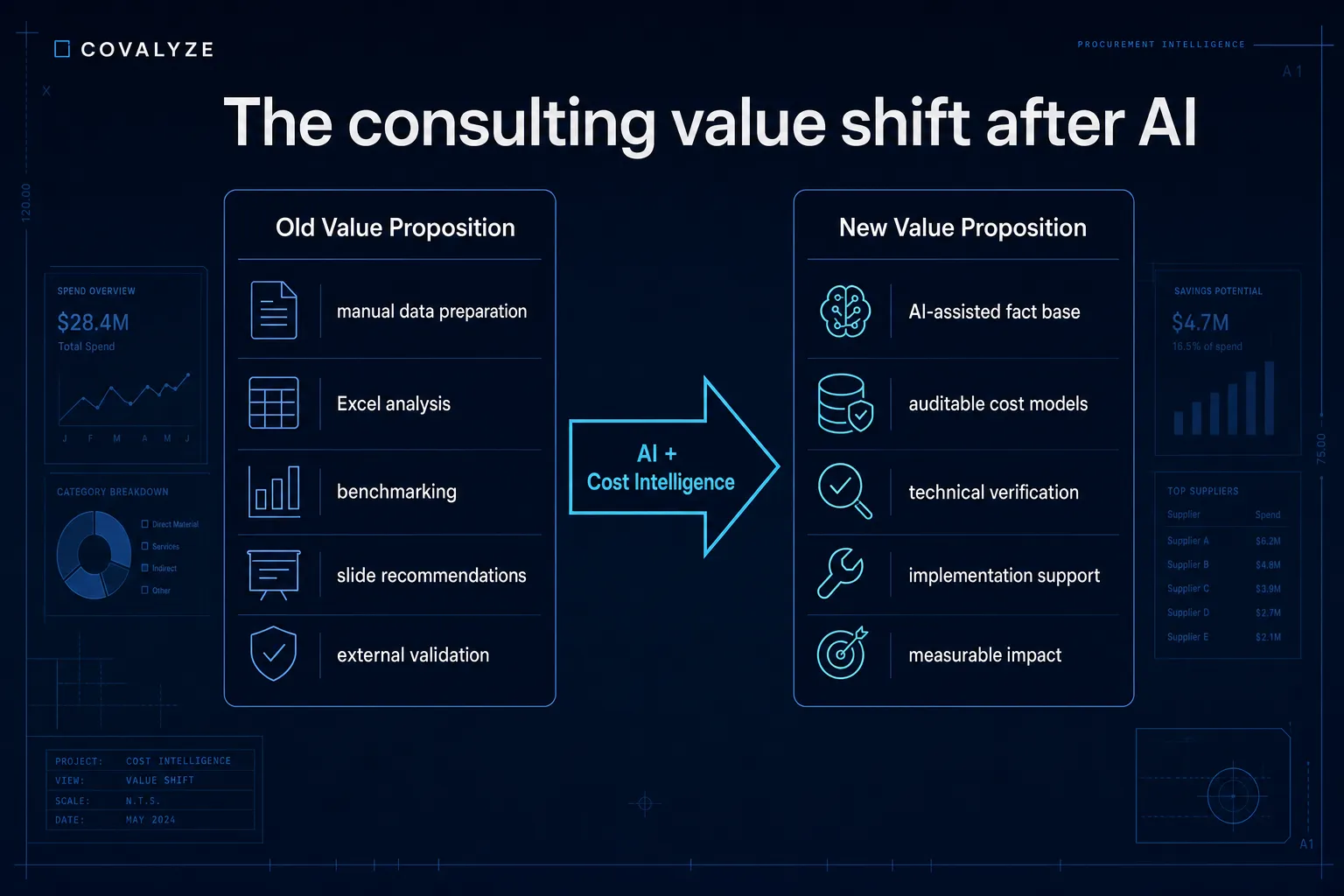
Why industrial cost analysis shows the shift most clearly
A supplier price is never just a number. It carries material, geometry, process steps, machine time, setup time, labor cost, energy cost, overhead, quantity, region and supplier strategy.
Traditional spend analysis shows what a company paid. It cannot say whether the price is technically plausible, and that gap is where the decisions get made.
If a supplier increases prices, procurement needs to know whether the increase is justified. If a company considers insourcing, management needs to know whether internal production is economically realistic. If a private equity investor evaluates a portfolio company, the deal team needs to know whether the business case rests on credible product costs.
This cannot be answered with average benchmarks alone. It requires a technical cost model.
From AI output to auditable cost models
In industrial environments, AI alone is not enough. A black-box recommendation may be fast, but speed does not make it credible. Procurement leaders, CFOs, COOs and investors need to understand how a result was calculated, which is what an auditable cost model provides.
An auditable manufacturing cost model must make key assumptions visible:
- material input
- geometry
- process sequence
- machine time
- setup time
- machine hourly rates
- regional cost assumptions
- raw material prices
- quantity effects
- overhead logic
That is the difference between an estimate and a decision basis. A model that can be reviewed can be trusted, transparent assumptions can be challenged constructively, and repeatable logic carries across suppliers, plants, regions and product portfolios.
How COVALYZE fits into this shift
COVALYZE is an auditable manufacturing cost model for technical parts and products rather than an AI tool that predicts savings. The logic is deliberately transparent:
- Technical parameters describe the part.
- Process formulas translate these parameters into machine and process times.
- Setup times and production assumptions are added.
- Regional machine, labor, energy and overhead data translate times into local manufacturing costs.
- The result becomes a transparent should-cost calculation.
COVALYZE does not start by calculating costs. It starts by calculating process times. Costs are the regional translation of those times.
The distinction matters in practice. The calculation runs on technical parameters and curated cost databases, not on a consultant nudging assumptions until the desired savings number appears. That makes the output transparent, repeatable and hard to manipulate.
Why this matters for consultants
AI does not remove the need for consultants. It raises the bar. Anyone whose value rests mainly on manual data work will feel the pressure, while consultants who bring technical expertise, tools, structured implementation and the ability to verify AI-generated results become more valuable.
The future role of consultants in industrial cost work includes:
- validating technical inputs
- challenging assumptions
- translating cost models into sourcing strategies
- preparing supplier negotiations
- running auctions or negotiation processes
- supporting make-or-buy decisions
- aligning procurement, engineering and finance
- turning analysis into implemented measures
- documenting impact
- helping management decide what to do next
Consulting value moves toward technical verification, execution and measurable business outcomes. It does not move toward prompting or toward producing more slides.
Why this matters for industrial companies
The change matters just as much on the client side. AI gives internal teams more analytical power, which does not automatically produce better decisions.
Companies often end up with the opposite problem: more outputs, scenarios and recommendations than anyone can verify. That is why AI needs auditable models next to it.
AI can accelerate the preparation of the fact base, but industrial decisions still require technical credibility. Before a company renegotiates with a supplier, changes a sourcing strategy, moves production to another region, insources a part or validates a business case, it has to trust the underlying numbers. COVALYZE builds that trust by making the calculation logic visible.
What result-driven consultancy looks like in practice
A result-driven industrial consulting model starts with a structured, technology-enabled fact base instead of a large team sorting data by hand for weeks. A typical workflow looks like this:
- ERP, spend, BOM and drawing data are collected.
- AI and automation structure, classify and enrich the data.
- Technical parameters are extracted or completed.
- COVALYZE calculates process times and should-cost values.
- The results are reviewed and validated.
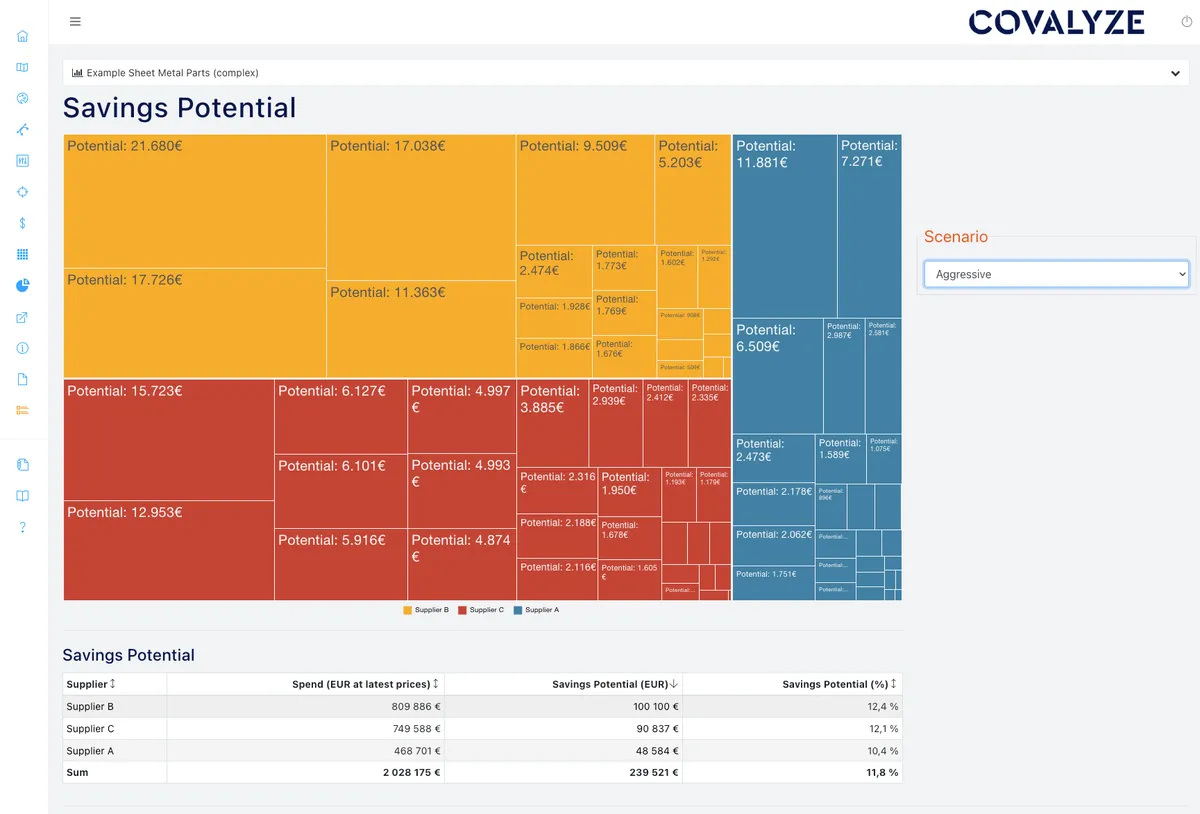
- Cost gaps are prioritized by supplier, part, category or product.
- Procurement and management decide where action is realistic.
- Consultants or internal teams support negotiation and implementation.
- Savings, risks and business-case effects are documented.
This shifts consulting from analysis-heavy work to action-heavy work. The question is no longer:
"Can we produce a cost analysis?"
The question becomes:
"How fast can we turn a verified cost model into business impact?"
Analysis-heavy to action-heavy
Instead of a generic reduction target, procurement can challenge specific parts, processes and cost assumptions.
The negotiation changes when every part carries its own cost logic
Once a should-cost model is verified, the conversation with suppliers stops being a demand for a flat percentage and becomes a discussion of material cost, machine time, setup time, overhead and regional cost drivers.

Supplier discussions get more fact-based, and internal teams and consultants can spend their time on prioritization, negotiation and implementation instead of rebuilding the numbers.
Use cases enabled by auditable cost models
1. Supplier negotiations
Procurement teams enter negotiations with a clear view of material cost, machine time, setup time, overhead and regional cost drivers. Instead of asking for a generic 10% reduction, they can challenge specific parts, processes or cost assumptions.
2. Make-or-buy decisions
Manufacturers can compare internal production costs with supplier prices, and decide whether a part should stay externally sourced, be insourced or move to another production region.
3. Product cost simulation
Engineering and management teams can simulate how product costs change with quantity, region, material or process assumptions, which matters most when launching new products or validating business plans.
4. Regional manufacturing cost comparison
Because process times are translated into regional manufacturing costs, companies can compare production scenarios across countries. That feeds sourcing decisions, footprint planning and localization strategies.
5. Business-case validation
Management can test whether a commercial plan is supported by realistic product costs. This applies to new product launches, large infrastructure projects, industrial investments and portfolio-company value creation.
6. Private equity due diligence
For investors, auditable cost models support technical commercial due diligence. Rather than relying on market growth, management interviews or high-level margin assumptions, investors can test whether product costs, quotations and operational improvement plans are realistic.
Outlook: why this becomes relevant for private equity
Private equity is moving into a more operational era of value creation. Higher interest rates, inflation, valuation pressure and more difficult exit environments make pure financial engineering less reliable. Investors increasingly need to create value inside portfolio companies through pricing, procurement, operations, product cost reduction and margin improvement.
This creates a natural role for technical cost intelligence. For PE investors, COVALYZE can support questions such as:
- Are product costs realistic?
- Are supplier prices technically plausible?
- Is the business plan based on credible manufacturing assumptions?
- Which parts or products carry hidden cost potential?
- Can EBITDA improvement be linked to concrete cost levers?
- Which sourcing or make-or-buy decisions could improve margins?
- How fast can a portfolio company identify and execute cost measures?
None of this replaces commercial due diligence. It adds a technical layer underneath it, making diligence more operational and more granular.

The new consulting standard
Industrial companies will still need external expertise, but the standard for the work is rising. The old model was built around analysis capacity. The new one is built around verified results.
Clients will increasingly expect consultants to answer four questions:
- Can you create a reliable fact base faster?
- Can you prove how the result was calculated?
- Can you help us implement the recommendation?
- Can you link the work to measurable business impact?
Where the answer is no, AI and internal teams will absorb more of the work. Where it is yes, consultants can be worth more than before, though the job looks different: AI and cost intelligence take out the manual effort, and the time goes into verification, prioritization, negotiation, execution and impact tracking.
Conclusion
AI is doing more than making consulting faster. It is changing what industrial companies are willing to pay for. Manual data preparation, benchmarking and number crunching lose value; auditable cost models, technical verification, implementation capability and measurable impact gain it.
In industrial cost analysis the shift is already visible, and COVALYZE supplies the auditable cost model behind it. Technical parameters become process times, process times become regional manufacturing costs, and the result is transparent, repeatable and usable for real decisions.
Number crunching is no longer enough. The future of industrial consulting is auditable, technical and result-driven.
See how COVALYZE Analytics and PartIQ turn a verified, auditable cost model into part-by-part negotiation leverage and measurable business impact.
Sources and supporting references
- TheStreet: AI is forcing McKinsey, BCG, Bain to rethink consulting fees. Supports the claim that AI is putting pressure on traditional consulting fee models and increasing interest in outcome-based pricing.
- Simon-Kucher: Private Equity, The Operational Era of Value Creation Accelerates. Supports the claim that private equity is shifting toward operational value creation and measurable execution.
- KPMG: Value Creation in Private Equity, 2025 Global PE Value Creation Survey. Supports the claim that PE firms face pressure from higher rates, inflation, valuation pressure and technological disruption, requiring more disciplined value creation.
- COVALYZE: PartIQ, Intelligent Part Analysis & Optimization. Supports COVALYZE's positioning around AI-powered technical analysis, drawing extraction and procurement optimization.
- COVALYZE: 3D Should-Cost Analysis for a Private Equity Portfolio Company. Supports the connection between COVALYZE, private equity, should-cost analysis and faster quotation / sourcing decisions.
- arXiv: Machine Learning-Based Manufacturing Cost Prediction from 2D Engineering Drawings via Geometric Features. Supports the broader technical trend toward automated cost estimation from engineering drawings and geometric features.