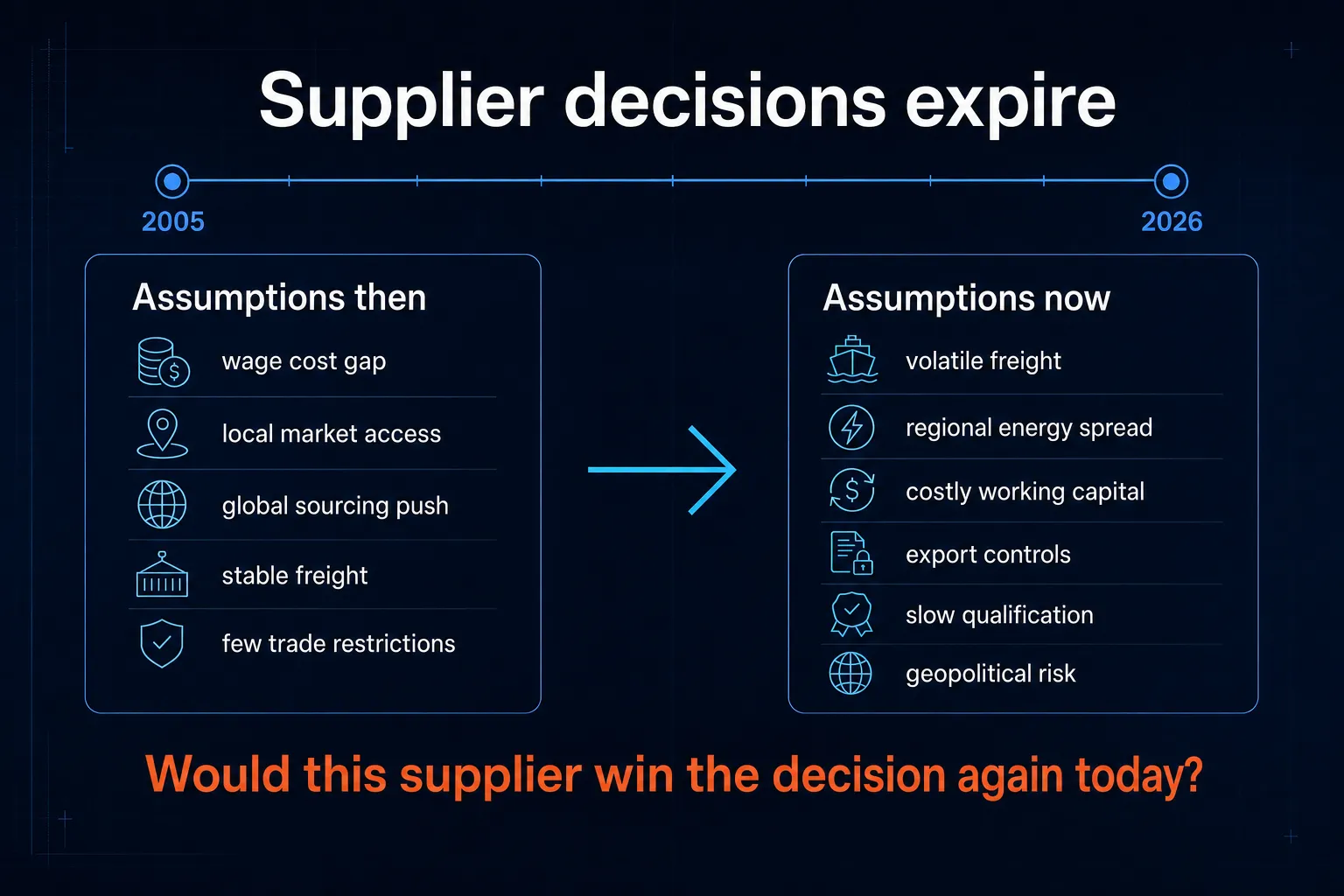
Many supplier decisions made 15 or 20 years ago were right at the time. They were based on the world as it existed then: labor cost differences, local market access, supplier maturity, logistics assumptions, the alternatives available and a strategic push toward global sourcing. In plenty of cases they created a real competitive advantage.
The world around those decisions has moved. A supplier that was the right choice in 2005 may be the wrong choice today, and usually not because the supplier got worse. The calculation that made that supplier attractive has expired. The risk sits in the missing recalculation rather than in the original decision.
The old global sourcing logic was rational
In the early 2000s, many large European industrial groups followed a clear sequence: build local supplier networks for China, then use the best of those suppliers for European products as well. That was not reckless procurement. It was often the right answer to the industrial reality of the period. China was becoming a major target market, and companies that wanted to sell there needed local supply chains. Local-for-local production reduced cost, improved market access and made it easier to adapt products to regional requirements.
Then came the part many companies underestimated: some of those suppliers became very good. What started as a local sourcing strategy turned into a global supplier strategy. Suppliers originally developed for local production became attractive for European products too, with a strong cost position, capabilities that improved quickly, growing scale and rising technical maturity.
The decision was logical. A sourcing decision that was logical in 2005 should not automatically survive into 2026.
The supplier may still be good. The business case may not be.
This is the distinction procurement teams have to make. A supplier can deliver acceptable quality, hold its approvals, sit in the ERP system and be familiar to engineering and purchasing, and the decision behind it can still be out of date.
Most supplier decisions are never recalculated with the discipline that went into making them. They become part of the operating system instead. The supplier is approved, the drawings are known, the purchase orders run, the logistics process works, the relationship is established, and the switching effort looks painful. Over time the original cost logic disappears behind master data, and a strategic sourcing decision turns into a habit. Habits are rarely challenged until something breaks.
Still true
What keeps the supplier in place
- quality is accepted
- the supplier is approved
- the catalog and drawings sit in the ERP system
- engineering and purchasing know how to work with them
- switching looks slow and expensive
No longer priced in
What the original award never accounted for
- freight cost volatility
- the energy price spread between regions
- the cost of working capital tied up in long supply chains
- customs, sanctions and export restrictions
- qualification and ramp-up times
- geopolitical risk as an operational factor
All of this can be true about the supplier while the assumptions behind the award have already moved.
The world around the supplier has changed
Labor cost gaps are no longer the only factor that matters. Freight costs move more sharply, energy prices differ strongly between regions, working capital tied up in long supply chains has become more expensive, and customs, sanctions and export restrictions carry weight they did not carry in 2005. Qualification runs slower than procurement teams would like. Geopolitical risk has stopped being an abstract scenario for the annual risk workshop.
Some supplier regions matured over those years; others lost part of their advantage. None of that makes distant sourcing wrong. It makes the old calculation insufficient. A supplier should not stay preferred because it won a sourcing decision under the assumptions of another decade.
Would we still award this supplier today if we had to make the decision from scratch?
What the automotive supplier crisis shows
The pressure on supplier networks is already visible in the numbers. EY's March 2026 analysis of the German automotive industry describes a sector under structural pressure, with supplier insolvencies reaching a 14-year high in 2025. Oliver Wyman's 2026 supplier study counts 257 insolvencies among automotive suppliers with more than EUR 10 million in revenue between 2020 and 2025, 59 of them in 2025 alone.
The lesson for procurement is not that suppliers can fail. It is that supplier weakness usually becomes visible well before failure.
Early warning
A supplier that cannot fund machines, automation and working capital is not cheap. It is a future supply risk.
A price can be too low to survive
Oliver Wyman highlights the net debt ratio as an early-warning indicator. That matters for procurement because a supplier that cannot generate enough margin to invest in machines, automation, quality systems and working capital is not simply inexpensive.

So cost analysis has two jobs, not one. The first is the familiar question of whether a supplier price can come down. The second is whether the supplier can keep delivering at the price it already quoted.
A supplier that is too expensive is a savings opportunity. A supplier that is too cheap to be sustainable is a continuity risk. Both belong in the sourcing decision.
Nexperia: a different kind of supplier risk
The Nexperia crisis is useful precisely because it is not a story about a weak supplier. It was not mainly about poor quality, bad operations or a supplier drifting into financial trouble. It was a geopolitical and regulatory shock around components that sat deep inside automotive electronics.
In many industries the most critical parts are not the most expensive ones. A low-cost component can stop a production line if it is hard to replace, sourced from a single region or locked into a qualification process.
Qualification
In regulated industries a supplier switch means testing, approval, documentation, validation and ramp-up.
An unprepared alternative is not an alternative
By the time a disruption is visible, the window for a quick reaction has usually closed. Even where alternatives exist on paper, switching takes months rather than days.

That is why supplier risk is no longer only a credit-rating topic. It is a cost-model topic, a qualification topic and a supplier-strategy topic at the same time.
The practical consequence is that alternatives have to be prepared technically and commercially while nothing is burning, which is exactly when nobody feels the urgency to do it.
Recalculate before the crisis, not during it
Procurement teams need to recalculate historical supplier decisions before they are forced to react. That does not mean replacing every long-standing supplier, which would be simplistic. It means testing whether the original decision still holds under today's assumptions.
Three questions decide the outcome:
- Are our main suppliers still competitive in total cost and performance?
- If not, which industrial clusters offer realistic alternatives?
- If no better alternative exists, should we develop the existing supplier instead of replacing it?
The questions sound simple and are not. A historical purchase price does not answer them. Neither does a spend cube, a supplier scorecard or a conventional benchmark. Answering them properly means knowing what the part should cost today, based on material, geometry, manufacturing process, machine time, setup time, quantity and region. That is the point where supplier strategy becomes a technical cost question.
The wrong question is which country is cheaper
Old global sourcing was organized around countries. Which country has lower wages, which country has lower supplier prices, which country can produce this more cheaply. That view is too narrow. The better question is which industrial cluster is strong in this specific value-creation step.
Michael Porter's cluster logic still applies here. Competitive advantage does not come from low labor cost alone. It comes from local concentrations of companies, suppliers, machinery, skills, knowledge, institutions and demanding customers.
Supplier search
The cheapest hourly rate and the lowest total cost are rarely found in the same place.
Map capability, not wage level
A metalworking supplier in one region can beat a cheaper supplier elsewhere when the surrounding cluster offers better machine availability, stronger process know-how, faster troubleshooting, shorter lead times, better tooling support and more qualified alternatives.
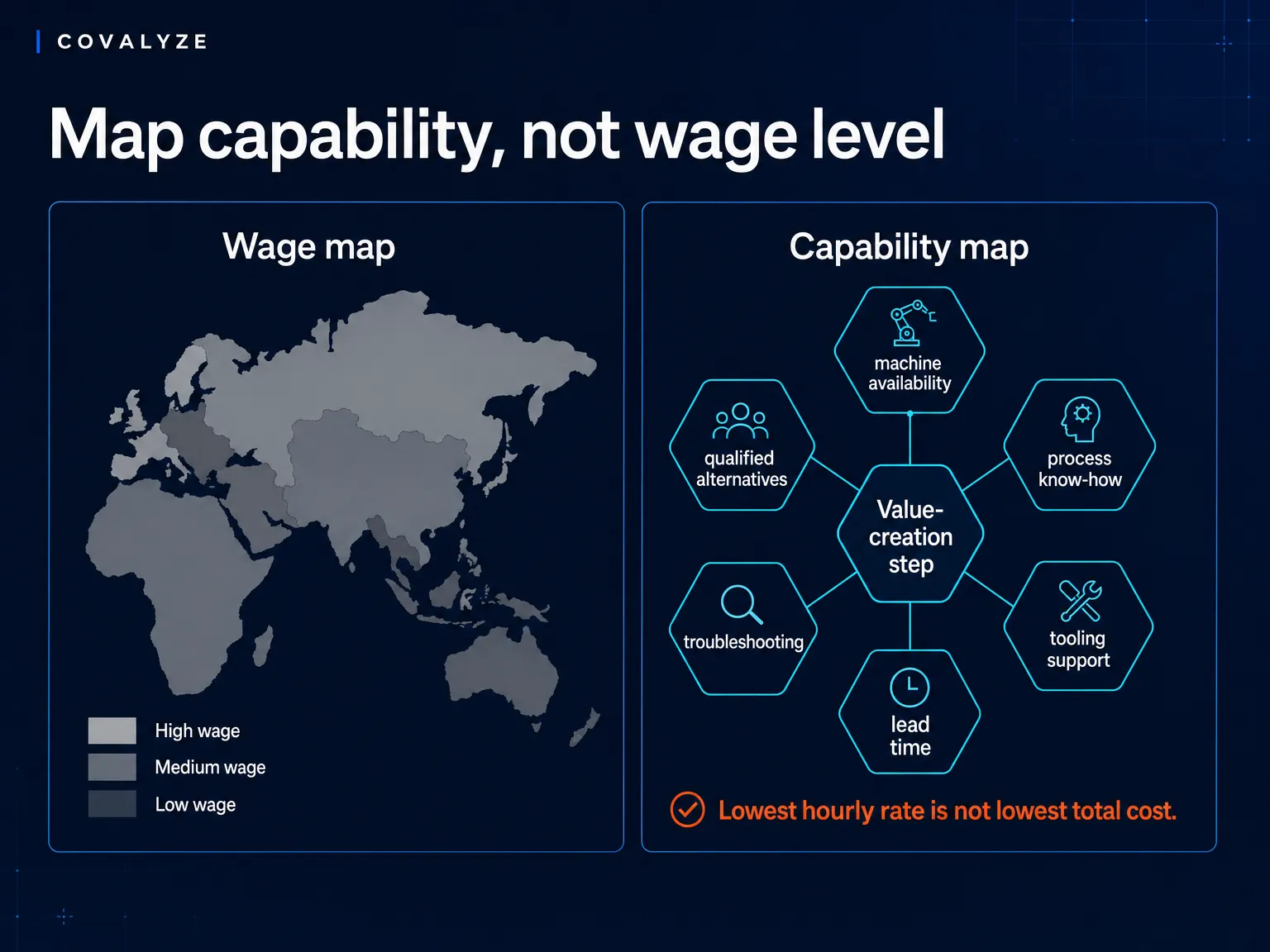
This matters for European companies weighing up Eastern Europe or other closer, more resilient regions. The point is not that one region always wins.
The point is that supplier search has to run on total cost, technical capability and risk instead of hourly rates.
Sometimes the answer is supplier development, not switching
If no better alternative exists, the right move may be to make the existing supplier competitive again. That is an investment decision rather than goodwill. Where a supplier is strategically important, technically capable and hard to replace, development can be cheaper, faster and less risky than qualifying a new one.
This decision needs its own calculation. Procurement and management have to understand why the supplier is no longer competitive, and the cost gap usually traces back to something concrete:
- outdated machines
- long setup times
- poor material utilization
- low automation
- small batch sizes
- high scrap rates
- energy cost
- overhead structure
- inefficient production planning
- missing tooling
- an unfavorable make-or-buy setup
Once the gap is visible, the development path gets concrete. A new tool may close it. So may a different batch strategy, a redesigned part, a machine investment, or a long-term agreement that gives the supplier enough security to invest. Without a cost model, supplier development stays a relationship discussion. With one, it becomes a business case.
How COVALYZE supports supplier recalculation
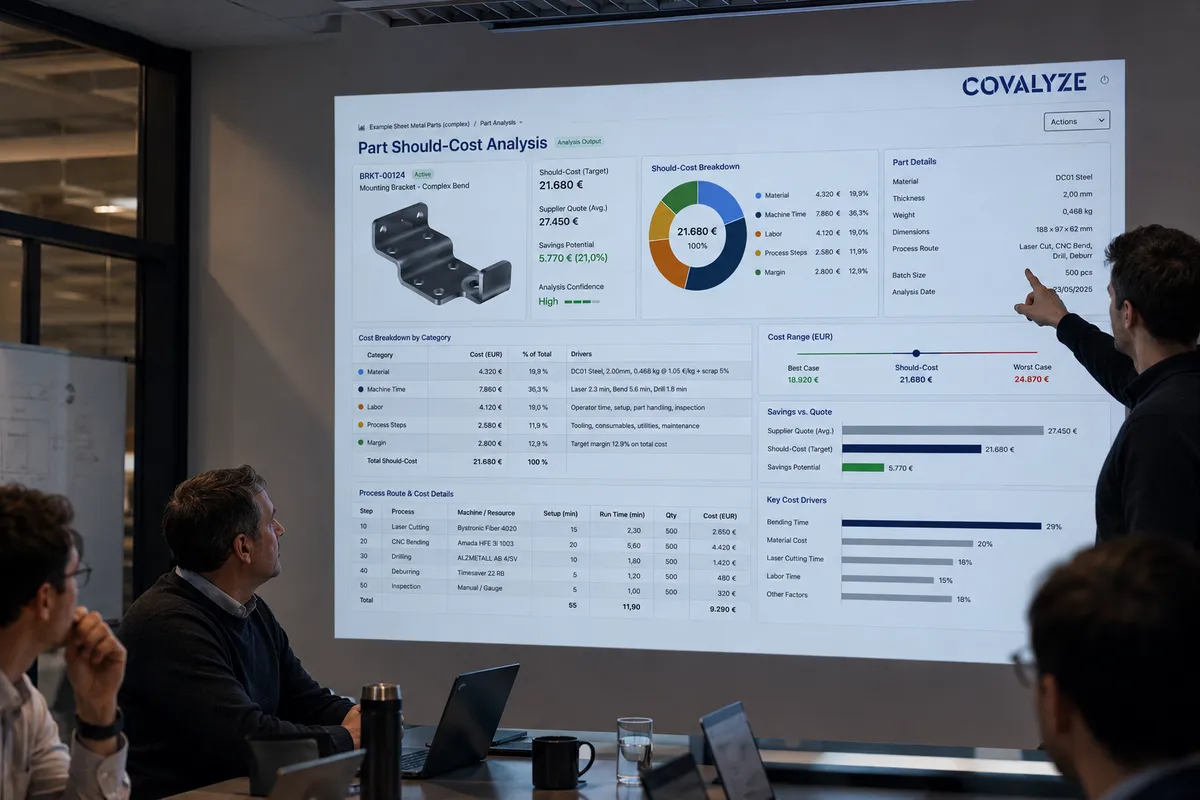
COVALYZE reopens the calculation behind historical supplier decisions at part level, with current cost, region and risk assumptions. The platform does not only show what was paid in the past. It calculates what a part should cost today.
That calculation starts from the technical reality of the part: material, geometry, manufacturing process, setup time, machine time and quantity. Those process-based values are then translated into regional manufacturing costs, which gives procurement a technical cost baseline.
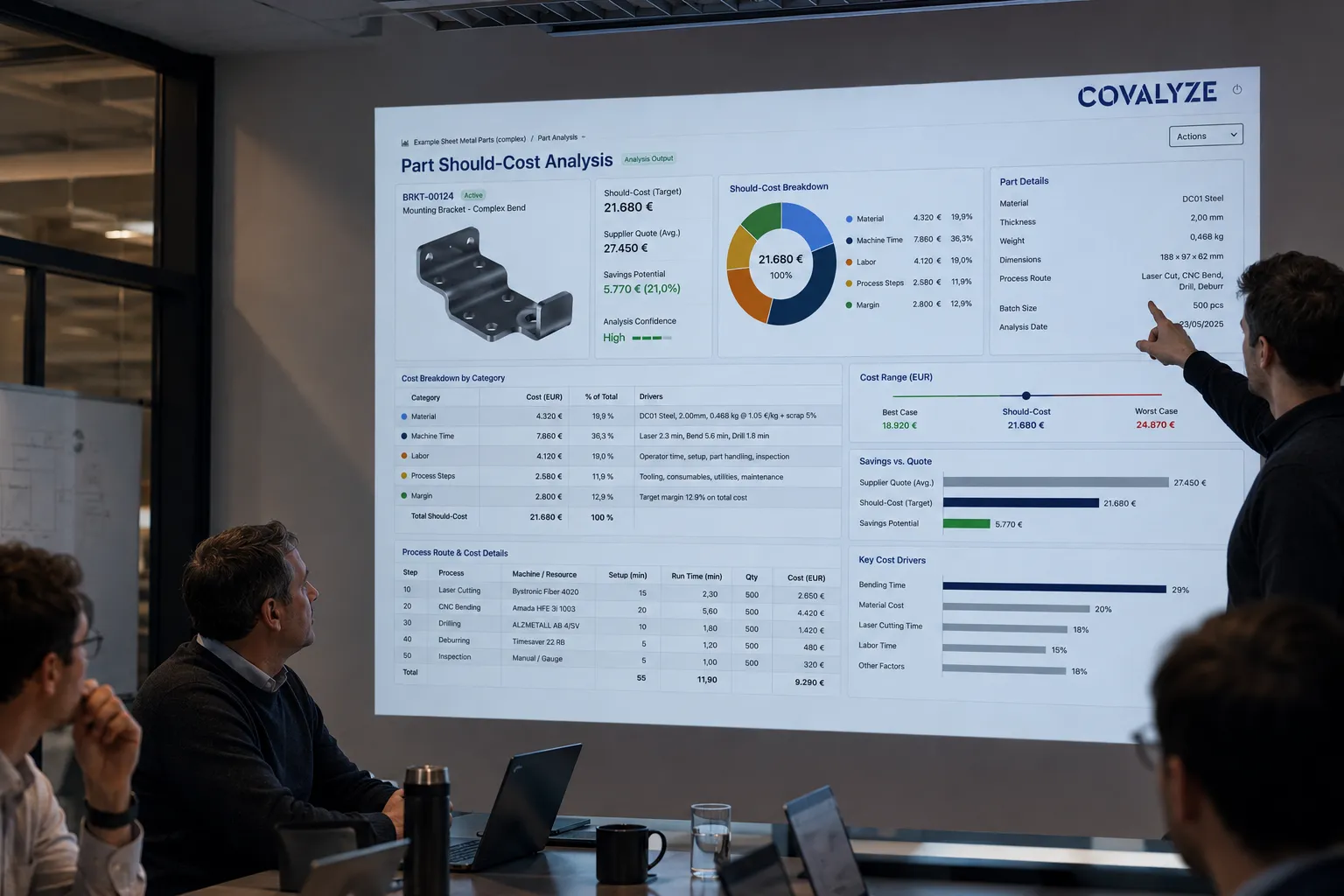
Once the baseline exists, the current supplier price can be compared against a transparent model, and the discussion changes immediately. Instead of "your price is too high," procurement can say where the gap sits: material usage, machine time, setup time, batch size, regional cost structure or overhead. That is a better conversation for both sides. It avoids generic price pressure, and it avoids blind trust in historical supplier prices.
From supplier review to supplier strategy
Recalculation produces a strategy rather than a list of suppliers to replace. Some suppliers should be challenged because their prices no longer match the technical cost baseline. Some should be defended because they are competitive and strategically important. Some should be developed because the relationship is worth keeping and the cost gap is fixable. Some should be dual-sourced because the risk is too concentrated. Some should be replaced because the original decision no longer holds.
What matters is that these calls come out of a recalculation rather than out of habit.
For the German Mittelstand this is especially pressing. Many mid-sized manufacturers work with long-standing suppliers, specialized parts, low to medium volumes and lean procurement teams. They cannot afford large supplier-switching programs, and they equally cannot afford to leave supplier decisions from another decade unchallenged. A supplier chosen 20 years ago may well still be the right partner, but that should be a calculated conclusion rather than an inherited assumption.
Conclusion
The supplier decision from 2005 was not necessarily wrong. In many cases it was exactly right for the world of 2005. But supplier decisions age. Cost structures, supplier clusters, geopolitical risk, qualification times, financial stability and regional competitiveness all move, and the award that captured them once does not capture them forever.
The strongest procurement organizations do not simply confirm old supplier decisions. They recalculate them, and the test is a short one: would this supplier win the decision again today?
See how COVALYZE Analytics and PartIQ turn technical cost models, regional manufacturing scenarios and supplier-specific cost drivers into a supplier strategy you can defend.
Sources and supporting references
- EY: Automobilstandort Deutschland, March 2026. Supports the structural pressure on German automotive suppliers, including the reported 14-year insolvency high.
- Oliver Wyman: Automobilzuliefererstudie 2026, Zwischen Schock und Gestaltungsspielraum. Supports the insolvency figures from 2020 to 2025, the 2025 level, margin pressure and the net debt ratio as an early-warning indicator.
- Reuters: Why Nexperia is at the centre of an autos chip crisis, 2025. Supports the argument that a supply-chain disruption can hit even when the supplier is not operationally weak, and that alternatives need long qualification and ramp-up.
- Michael E. Porter: Clusters and the New Economics of Competition, Harvard Business Review, 1998. Supports the cluster logic: regional concentrations of suppliers, skills, knowledge and institutions shape productivity, innovation and competitiveness.
- COVALYZE: Client Results and PartIQ, Intelligent Part Analysis & Optimization. Support the positioning around technical cost analysis, part-level should-cost logic and procurement analytics.