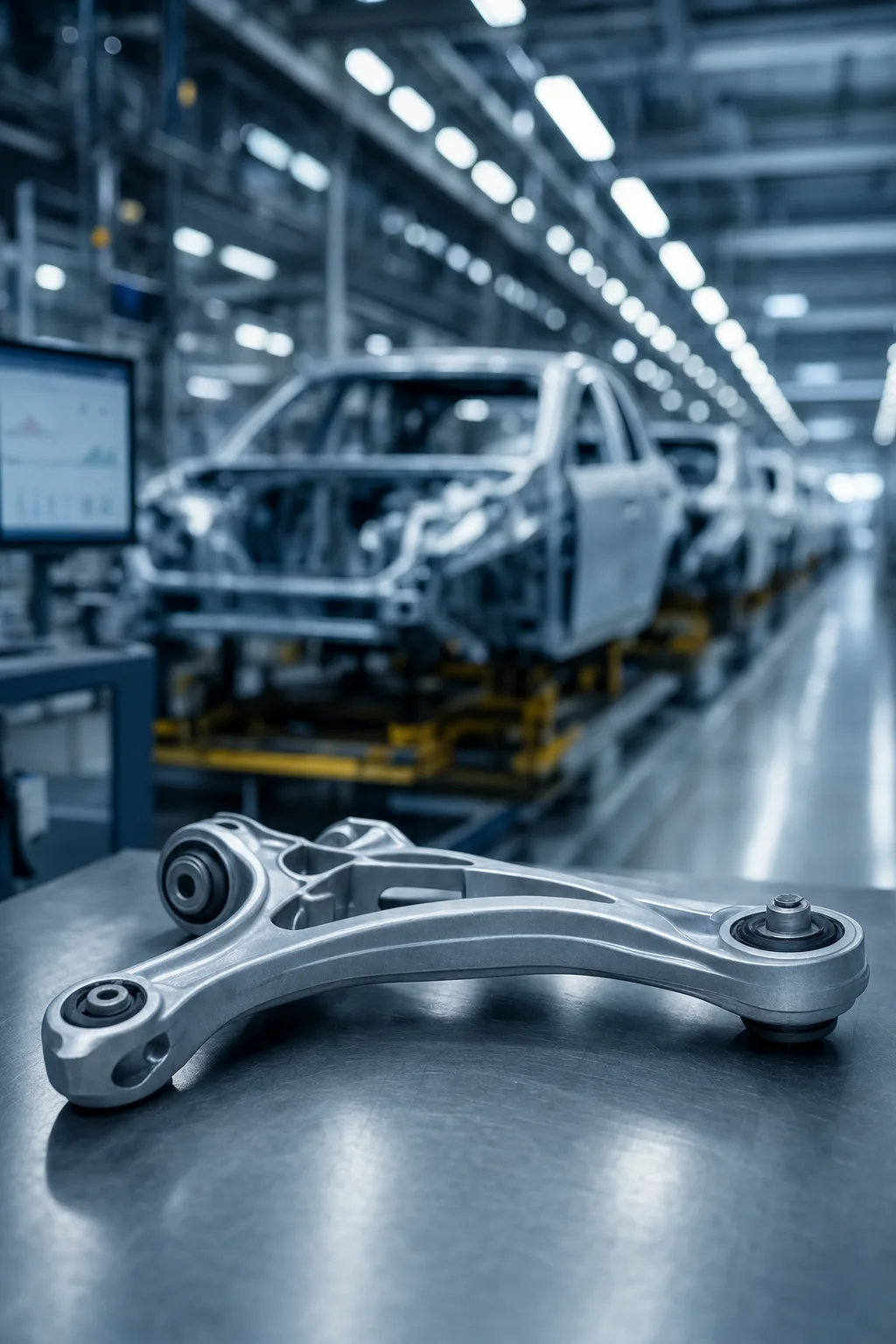
The automotive supplier industry lost nearly 80,000 jobs over the last 18 months, with over 54,000 cut in 2024 alone. What sits behind those numbers is a permanent shift in how value is distributed across the supply chain, not a cyclical downturn.
Who is bearing the pressure
The pressure has a specific profile rather than a broad industry one: mid-sized automotive suppliers with revenues between €50M and €500M. Procurement leaders and CFOs at Tier-2 and Tier-3 manufacturers across machined parts, metal components, plastics and injection molding, and electromechanical systems.
These companies are too small to influence OEM terms, yet too exposed to avoid them.
What has structurally changed
Three developments define the new reality for suppliers.
1. RFQ complexity has exploded
What used to be under 100 pages is now 300-500+ page tender packages. Requirements extend far beyond the product itself: CO₂ and ESG compliance, IT security standards, process constraints. Suppliers must accept all of it, regardless of feasibility or cost impact.
2. Cost engineering has become a pricing weapon
OEMs increasingly rely on "Greenfield" cost models, built on theoretical best-case assumptions, often disconnected from real production constraints. BCG's Global Automotive Supplier Study 2026 confirms this directly: OEM margins are declining, and the pressure is being passed structurally downstream. What arrives at the supplier is a target price set elsewhere, not an opening position in a negotiation.
3. Volume risk has been transferred to suppliers
Business cases are built on 5-7 year volume assumptions. In reality, deviations of 30-50% are common. Price reductions are fixed. Volume risk sits entirely with the supplier. Dentons' 2026 Automotive Restructuring Briefing and Capstone's Automotive Industry Update both document the pattern: uneven demand recovery, volume pressure in key markets, and financial instability when suppliers fail.
The consequence: margin erosion by design
These mechanisms do not occur in isolation, they compound. Prices are pushed down using theoretical models while volumes stay unreliable, and the cost side, energy, labor, materials, cannot be adjusted at the same speed.
The result is predictable: profitable business cases become loss-making over time. Berylls' 2025 supplier study is direct on this point: suppliers face structural headwinds, not short-term cyclical issues. An EU automotive supply chain vulnerability study reinforces this, documenting increasing dependency on global supply chains, particularly from China, as a structural, not temporary, condition.
This is not mismanagement. It is system design.
Why this is accelerating now
Two external forces are amplifying the underlying pressure.
The EV transition
New component categories, shifting value chains, and platform uncertainty reduce supplier leverage. Long-term volume commitments are harder to secure, and harder to rely on when given.
Global price competition
Chinese EV manufacturers are entering European markets at price points up to 40% lower. OEMs are absorbing this pressure, and compensating by extracting margin from procurement. ZF Friedrichshafen's €1 billion loss in 2024 is one of the clearest public signals of what this looks like at scale. Supply chain instability, from chip shipment disruptions to geopolitical constraints, adds further operational risk that suppliers must absorb without corresponding price relief.
Industry shakeout
Suppliers that build cost transparency into their commercial process gain a structural advantage in OEM negotiations.
What happens to suppliers that don't adapt
The outcome for suppliers operating under traditional assumptions is not abstract. Baker Tilly's survey of German automotive suppliers found that 67% of respondents expect competitors to exit the market within two years. Cost pressure is identified as the primary driver.
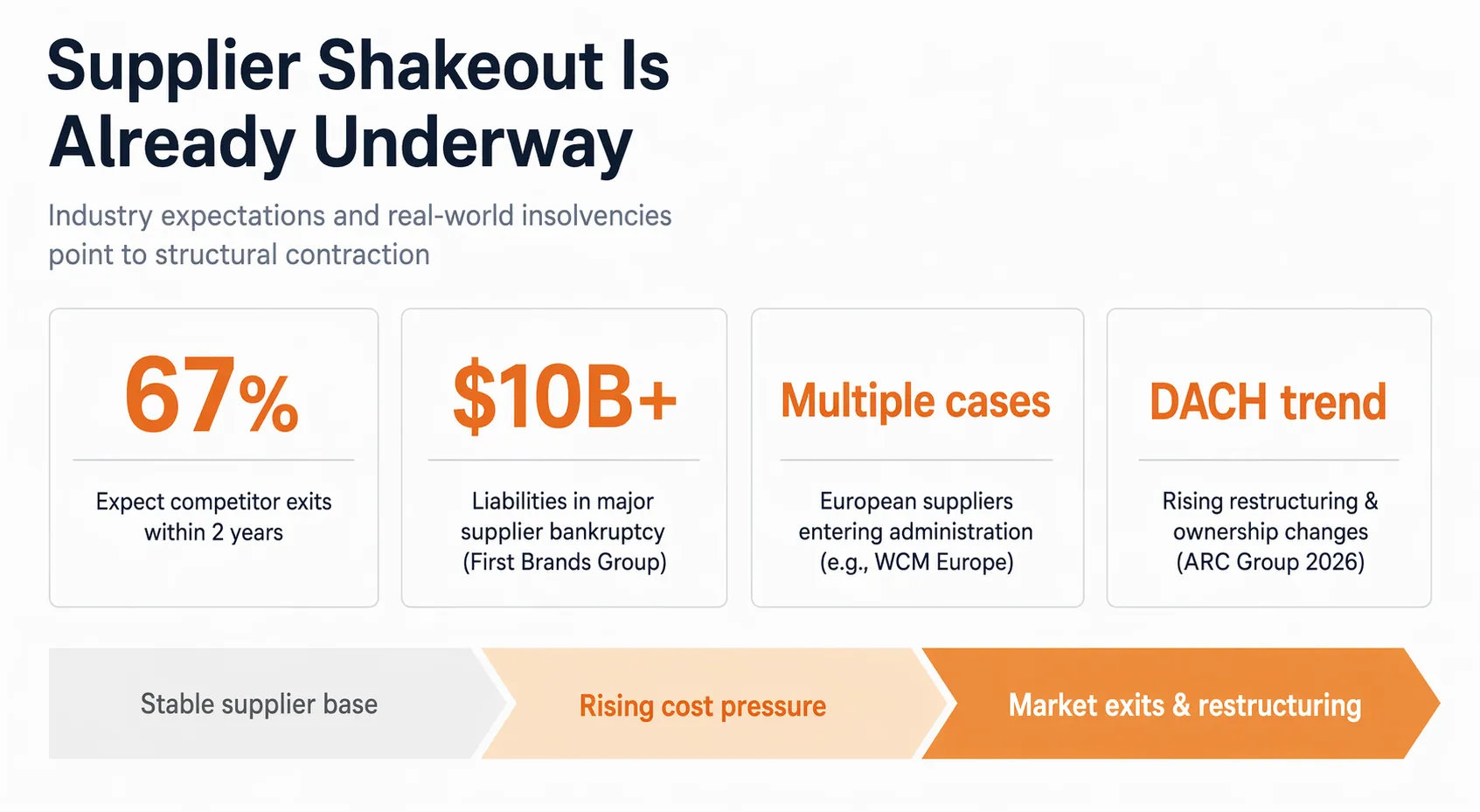
Recent insolvencies confirm this is already underway. First Brands Group entered bankruptcy with liabilities in excess of $10 billion. Long-established European suppliers, including WCM Europe, have entered administration. ARC Group's 2026 restructuring analysis documents a broader trend across the DACH region, with suppliers increasingly requiring restructuring or new ownership to survive.
These read less like exceptions and more like early signals of the shakeout that survey data suggests the industry itself expects.
The broken assumption
For decades, the operating assumption in the supplier community was that technical excellence ensures long-term business. That no longer holds. Technical excellence is necessary but not sufficient, and survival now depends on cost transparency and negotiation capability at OEM level.
What needs to change
Three areas require a fundamental rethink.
Pricing is no longer an internal exercise
Suppliers are not pricing based on their own costs in isolation, they are negotiating against external cost models built by OEM purchasing teams with dedicated analytical resources. The two sides are not working with the same analytical firepower.
Excel is not a defense
Manual models cannot scale across complex RFQs, react to parameter changes, or compete with OEM-level analytics. The speed and depth of OEM cost engineering has outpaced what spreadsheet-based approaches can match.
Speed becomes a strategic factor
Decisions must be made across hundreds of parts, under time pressure, with incomplete information. Suppliers that cannot structure and analyze RFQs rapidly are at a structural disadvantage before the negotiation begins.
What to monitor
To stay competitive, suppliers need ongoing visibility into four areas:
- True production cost drivers, by part, by process, by volume tier
- Volume sensitivity, how cost structures shift as forecast assumptions change
- Deviations between internal and external models, where OEM assumptions diverge from operational reality
- Sub-supplier cost structures, to understand exposure further down the chain
Without this, every negotiation is reactive.
Bottom line
The automotive supply chain is no longer negotiated in the traditional sense, it is increasingly dictated.
If you cannot quantify your costs at the same level as your OEM customers, you are not negotiating. You are accepting terms.
Sources: BCG Global Automotive Supplier Study 2026 · Automotive Logistics, European Supplier Crisis · Baker Tilly German Supplier Survey · Berylls Supplier Study 2025 · Dentons Restructuring Briefing 2026 · Reuters, ZF March 2025 · WSJ, First Brands Bankruptcy · ARC Group, DACH Reshuffle 2026 · EU Automotive Supply Chain Study