Opening Brief
At a Glance

Our Client
Our client is a very large global company in the mechanical engineering sector, with a broad and diverse machine portfolio and a worldwide presence. As an OEM with significant procurement responsibility for electronic components, it manages a complex supplier base for parts embedded across its product range.
The engagement began with a specific request: could COVALYZE PartIQ expand the technical data basis for approximately 190 active microcontrollers, where only five parameters were initially available? What followed was far more than a data enrichment exercise. Using PartIQ and COVALYZE Analytics, the project expanded into a full procurement transparency initiative — delivering pricing logic, supplier leverage insights, and a foundation for long-term component standardization.
Key Figures
Active electronic components provided by the client with only 5 initial parameters each.
Total technical attributes after MPN-based enrichment from external catalog sources.
Final analytical basis after filtering statistically sparse and unreliable attributes.
Active supply base across which spend was distributed prior to consolidation.
Total spend represented by the analyzed microcontroller population.
Indicative optimization opportunity across the assessed purchasing volume.
Problem Frame
The Challenge
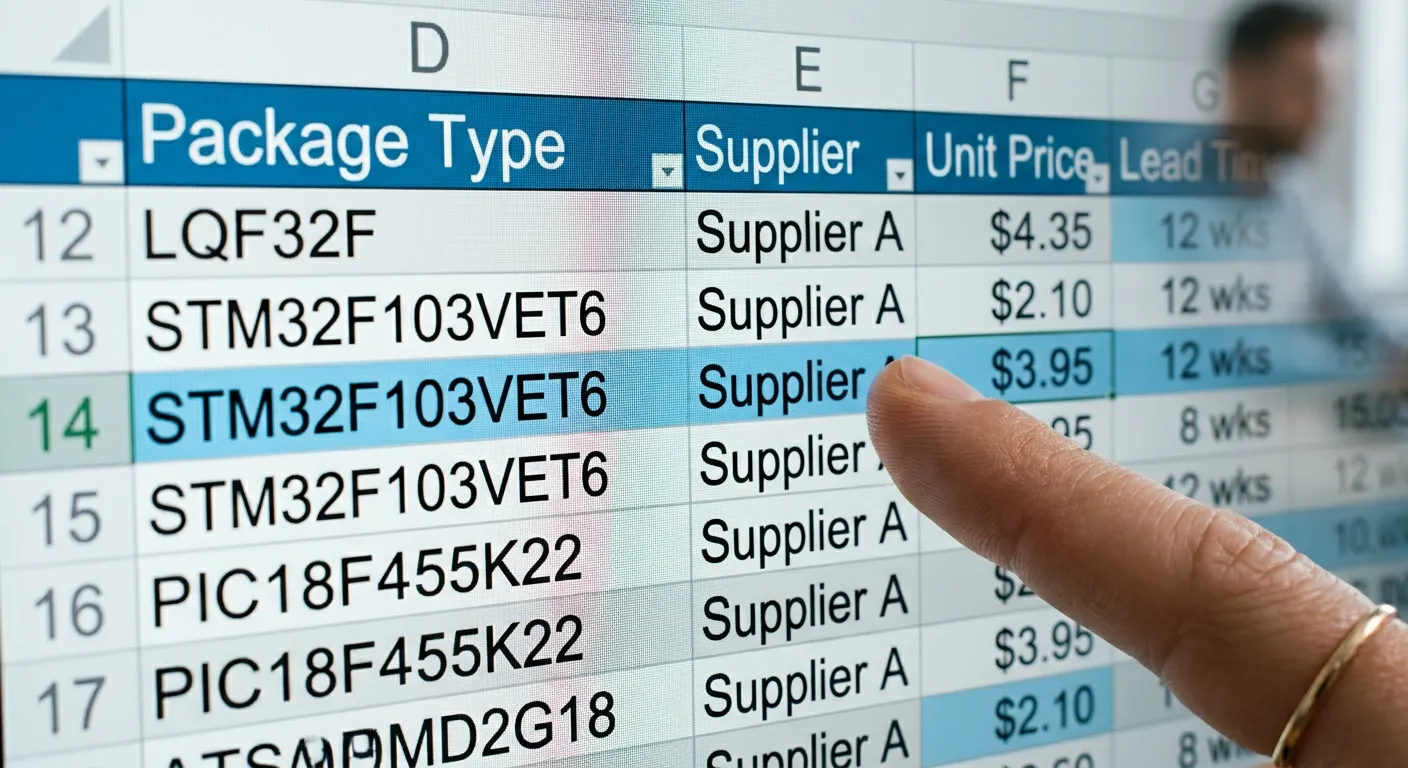
The client's internal dataset was extremely thin: 190 microcontrollers, each described by only five technical parameters — one of which was effectively unreliable.
What the Client Started With
The initial dataset provided by the client contained the following five attributes per part:
- » MPN number (used as primary identifier)
- » Pin count
- » Operating voltage
- » Temperature range (min / max)
- » Weight in kilograms — unreliable due to Excel rounding at that scale
This thin data foundation made it impossible to model price behaviour, compare parts across suppliers, or identify consolidation opportunities with any confidence.
What Made the Data Difficult
- » External catalog sources used inconsistent and supplier-specific label names for identical parameters
- » Not every part had values for every parameter — distinguishing missing data from valid zeros was critical
- » Package-related attributes existed but were fragmented across different catalog structures
- » Pin count, the strongest cost driver, appeared under multiple naming conventions across platforms
Visibility Gap
With more than €7 million in purchasing volume distributed across 20+ suppliers, the client lacked the technical transparency needed to negotiate with confidence, identify substitution opportunities, or consolidate its supply base. The risk of continuing was not just financial — it also meant accumulating unnecessary component variety that would complicate future product development.
Execution Design
Our Approach
Source Benchmarking & Data Enrichment
Using COVALYZE PartIQ, the team first identified the best-performing external data source, then systematically enriched all 190 microcontrollers through MPN-based catalog matching.
Platform Benchmarking
Multiple online catalog and distributor platforms were tested and ranked by match rate and return rate against the 190 MPNs. The best-performing source was selected as the primary enrichment platform.
MPN-Based Enrichment
Using the MPN as a unique key identifier, PartIQ extracted and structured technical data from the selected platform, expanding the dataset from 5 to 200 parameters per microcontroller.
Label Harmonization
Inconsistent supplier-specific naming conventions were mapped to a unified label set. This translated heterogeneous catalog fields into a single, comparable parameter logic across all 190 parts.
Parameter Harmonization & Reduction
The enriched dataset initially contained 200 parameters per part. The team then applied a structured reduction process to arrive at the ~80 parameters that were statistically robust and analytically relevant.
What Was Filtered Out and Why
The reduction from 200 to ~80 parameters involved removing:
- » Weight in kilograms: values in this unit were too small and likely distorted by spreadsheet rounding artifacts
- » Parameters with fewer than 5–6 part-level entries: statistically insufficient for model inclusion
- » Duplicate or redundant fields arising from naming variation across catalog sources
A critical precision requirement was distinguishing between a genuinely missing value and a valid zero — for instance, a microcontroller with 0.00 MB of a specific memory type is not the same as one with no data recorded. This distinction was essential for building a reliable pricing model.
From 5 to 200 to 80
The enrichment journey moved through three stages:
Statistical Modeling & Scenario Development
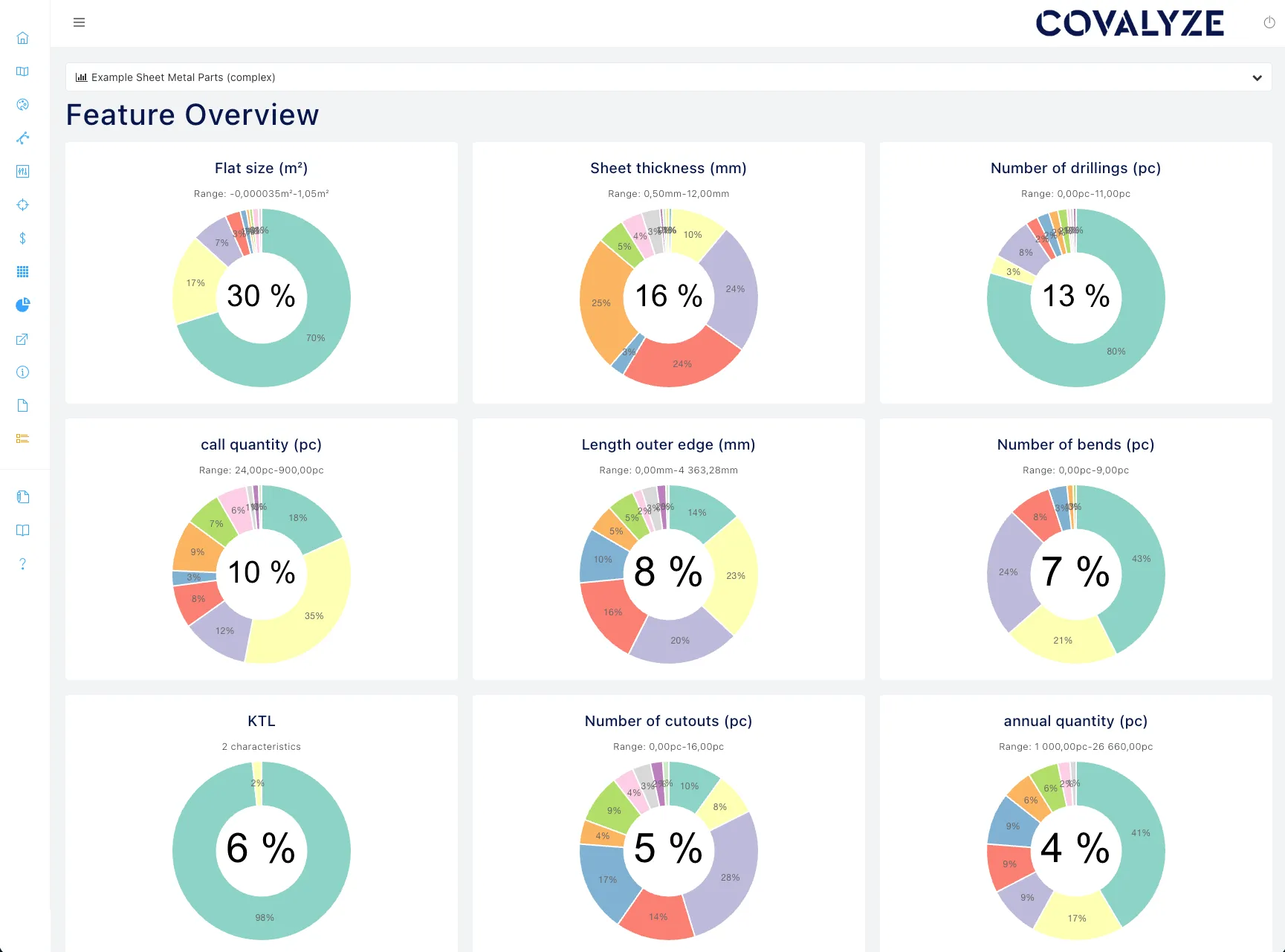
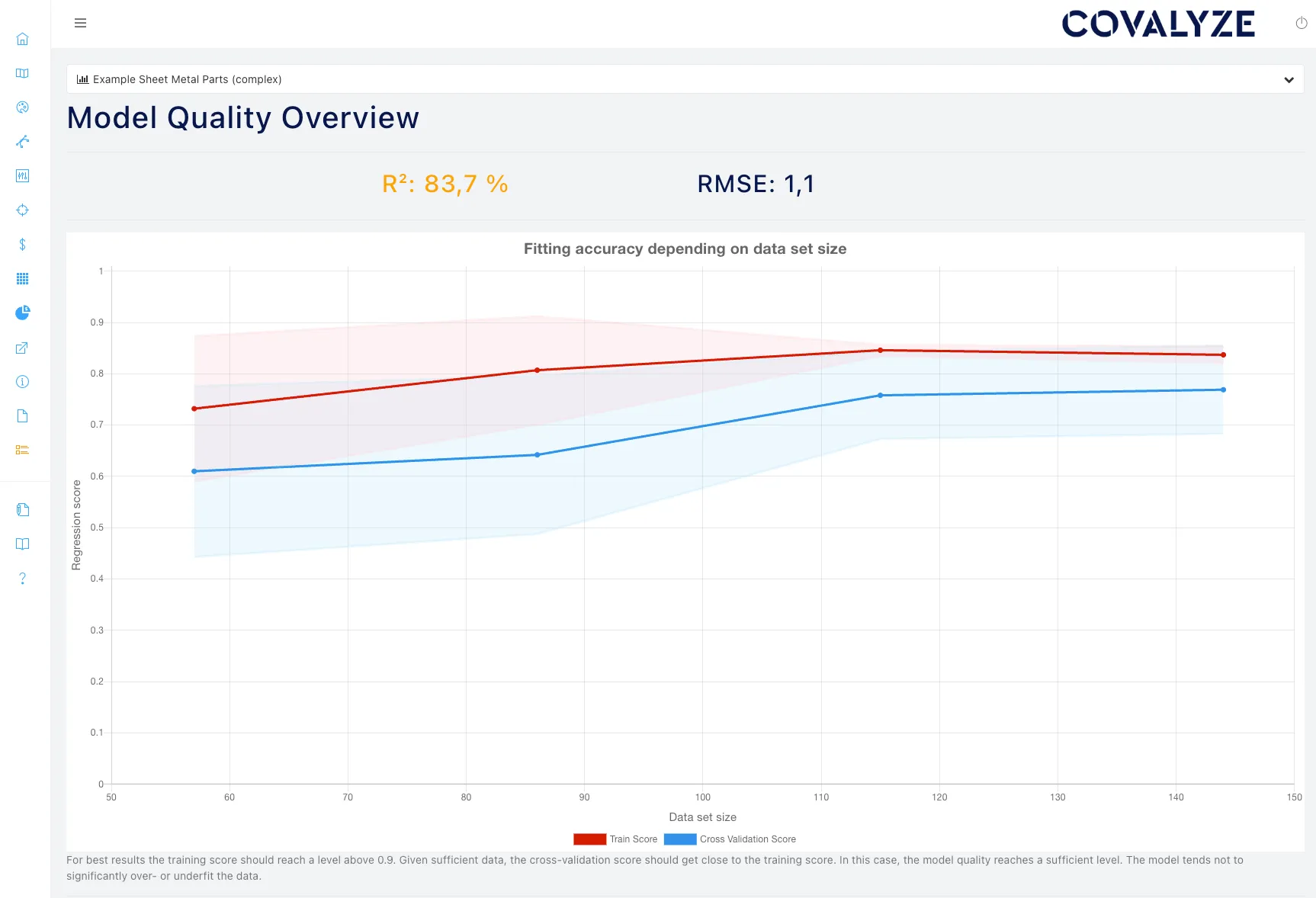
Using COVALYZE Analytics, the team built a statistical pricing model across all 190 microcontrollers. The model achieved 92% overall quality — an exceptionally strong result for this type of analysis.
Cost Drivers Identified
The model quantified the contribution of each technical attribute to observed price differences:
Primary driver — the single strongest explainer of microcontroller price across the dataset.
Second driver — significant independent contribution beyond pin count.
Surprisingly low — volumes did not materially explain observed price differences.
Surprising Finding
Quantity explained only 7% of price variation — far less than expected. This finding fundamentally shifted the negotiation logic: volume bundling alone would not unlock savings. Technical comparability and supplier consolidation were the real levers.
Optimization Scenarios Developed
Based on the model output and similar-part clustering, four targeted optimization scenarios were identified:
Supplier consolidation by shifting volume from the long tail of small suppliers toward a core group with stronger leverage positions
Similar-part substitution for technically equivalent microcontrollers with lower list prices or better commercial terms
Specification reduction for future designs by limiting the variety of microcontroller types approved for new products
Targeted negotiations using pin count and memory as the primary pricing reference points instead of unit price alone
Outcome & Impact
The Result
By expanding the technical basis from 5 to ~80 relevant parameters and building a statistical model with 92% quality, the client gained a procurement transparency capability it had never had before — across a spend base of well over €7 million.
What the Client Can Now Do
The project enabled the organization to:
- » Evaluate all 190 microcontrollers on the basis of ~80 relevant technical parameters, not just 5
- » Identify technically similar or substitutable parts with confidence
- » Understand which attributes actually drive price — and use that logic in supplier negotiations
- » Assess where component variety can be reduced in future product designs
- » Move volume strategically across 20+ suppliers based on leverage and technical comparability

“What began as a request to enrich missing microcontroller data became a strategic transparency tool — giving the client a clear view of what drives cost, where suppliers can be challenged, and how component variety can be reduced for future designs.”
Active electronic components provided by the client with only 5 initial parameters each.
Total technical attributes after MPN-based enrichment from external catalog sources.
Final analytical basis after filtering statistically sparse and unreliable attributes.
Active supply base across which spend was distributed prior to consolidation.
Total spend represented by the analyzed microcontroller population.
Indicative optimization opportunity across the assessed purchasing volume.
What began as a data enrichment task became a decision system for procurement and engineering.
From Data Gap to Procurement Intelligence
Before the project, the client's procurement team could see only a thin and partly unreliable snapshot of its microcontroller population. After it, they had a structured technical-commercial database with measurable pricing logic, supplier leverage analysis, and a similarity map for substitution and standardization decisions. The approach is directly repeatable across other electronic categories — and the methodology for source benchmarking, label harmonization, and driver quantification transfers to any standard catalog part.